🚀 Zaprep: Your Socials on Steroids. Start free — automate 1,000 DMs/month & turn engagement into leads. with 1,000 automated DMs/month.
Submit your Tool
PoweredByAI.app is an AI Tools Directory helping individuals, businesses, and creators discover the best AI tools for writing, coding, design, productivity, and more.
© 2026 , Product of011BQ. All rights reserved.

Ollie, a startup whose mission was to deliver an AI assistant that respected its users’ privacy, says that it will be shutting down in a week. Bill Lennon, the company’s co-founder and CEO,took to Xon Friday to deliver the news, noting that the app will officially shut down on November 6. “I’m really proud of what we accomplished,” Lennon said. “We built an incredible personal assistant with a small team, and learned a ton. I’m grateful to our amazing team, our users, our investors, and everyone who supported us on this journey.” The text-based AI assistant markethas explodedover the past year, as the increasingly powerful models that undergird such applications have made them significantly more useful for daily tasks. Ollie, which discussedits $7.5 million seed roundled by Khosla Ventures with TechCrunch in September, offered a subscription-based model. The assistant was focused on helping families stay connected and organized. The app connected to a user’s email and calendar, while also providing integrated functions to help with appointment bookings, meal planning, and bill payments. The company had also planned to eventually move into household budgeting. Crucially, Ollie was one of the first mainstream apps that managed to achieve SOC 2, a privacy compliance standard that companies can attain via an independent audit. Unfortunately, user privacy has never been a hugely profitable aspect of the tech industry. If anything, many new digital assistants present unique privacy challenges for their users — as companies likeInstinct have shown. Ultimately, the pressures of the burgeoning AI industry took a toll on the company, Lennon said. “We got close, but ultimately couldn’t keep up,” he added. “With Muse, Instinct, and others entering the space, it became harder to stand out, grow, and raise the capital we needed to succeed.” Ollie’s customers will receive instructions on how to export data and receive refunds in the coming days, Lennon added.
View

Nvidia is in talks to guarantee billions in debt financing for AI cloud provider Nscale’s planned Anthropic data center in West Virginia, The Informationreported Thursday. Bloomberg latercorroboratedthe report. Anthropic has signed a $44.6 billion contract for the project’s first building alone, according to Nscale’sIPO filing. In essence, the chipmaker would be co-signing a customer’s loans, a sign of how hard the AI industry is working to keep its buildout plans afloat as investorsgrow jitteryabout the amounts of money involved. The proposed arrangement would help Nscale secure financing for the electricity and construction costs of its West Virginia campus. Under what’s known as a residual value guarantee, Nvidia would step in if Nscale defaulted on construction payments, temporarily take over the facility, and help find a buyer and new tenant,according to The Information. Nvidia’s earlier support for cloud providers has mostly covered leases and chip purchases, not construction. The stakes are high for Nscale, which isseeking to go publicat a valuation of up to $35 billion despite growing concerns about its ability to deliver on ambitious data center projects. Anthropic’s contract with Nscale covers the first 460-megawatt building at Nscale’s West Virginia campus, which is expected to use Nvidia’s next-generation Vera Rubin chips. The companies are also discussing asecond dealworth roughly $45 billion for another building. Nscale has struggled to get its projects off the ground. The company had about25,000 advanced AI chips running in August, a fraction of the nearly 500,000 it plans to deploy. Its West Virginia campus has run into trouble of its own. Runoff from the construction site hasflooded nearby homesmore than once. In September,after months of negotiations, the project won state certification. This month, Microsoftpulled outof a planned Nscale site in England after grid power for it was pushed into the 2030s. Nvidia has been a major financial backer of the sector,extending roughly $170 billionin investments and credit support to neoclouds and large customers, according to The Information. That includes $1 billion in convertible financing committed to Nscale in September. Neoclouds, which rent out AI computing power without a cash-rich core business behind them, have come under pressure from investors. Shares of CoreWeave, Nebius, and IREN had each fallen more than 30% in October as of last week,CNBC reported. The proposed guarantee would deepen Nvidia’s financial ties to Nscale while helping secure a major customer for its chips. Anthropic, one of the largest buyers of AI computing power, has spread its infrastructure spending across multiple chipmakers. One investor told The Information that Anthropic’s involvement likely explains Nvidia’s interest in keeping Nscale’s project on track. The discussions also come as Anthropicfaces questionsabout how it will finance its own rapid expansion. The company filed to go public this week, but Blackstone has warned investors that Anthropic may receive abelow-investment-gradecredit rating after its IPO. A junk rating would raise Anthropic’s borrowing costs and could push it to keep relying on stronger partners to back its debt.

Investors are getting nervous about AI infrastructure spending just as the Big Tech companies double down. Over the past two weeks, Alphabet, Amazon, Meta, and Microsoft have outlined plans to spend more than $740 billion on capital expenditures this year, which Wall Street is reading as AI infrastructure spending, including data centers and chips. Earlier in the AI boom, investors largely rewarded such big outlays, viewing them as a sign of confidence in the technology’s growth potential. But as we enter the fourth quarter, that enthusiasm seems to be giving way to concerns about negative free cash flow (spending more cash than a company brings in), mounting debt, and whether these enormous investments will ever generate enough returns. The anxiety spilled across the market on Friday. The Nasdaq fell 2.9%, and chip stocks took a drubbing, too: Nvidia dropped 4%, Broadcom more than 5%, and Qualcomm 11%. Alphabet, which plummeted 12% on Thursday, its worst day on record, wiping out $500 billion in market value, fell again. A big part of the concern is that companies that used to have overflowing free cash flow from their core businesses are getting hit as AI threatens the economics of those businesses.Alphabet provided the clearest exampleof that this week. Google’s parent company reported negative free cash flow of $9.1 billion in the third quarter, its second consecutive quarter in the red, even as quarterly capex grew to $51.4 billion. Alphabet expects to spend up to $205 billion this year, and expects that spending to keep rising in 2027. Meanwhile, the wild success of AI Mode — Google’s AI-powered chatbot feature built directly into Search — is eating into the company’s money-maker. Google’s Search advertising business, which makes up roughly half of its revenue, saw growth slow to 12%, its weakest pace in five quarters. That leaves Google walking a tightrope. It’s spending billions on the AI technology that could undermine the search business that pays it. Amazon is in a similar boatafter reporting negative free cash flow of $42.4 billion over the past 12 months, compared with $14.8 billion in positive free cash flow the year before. The company says it expects to spend $220 billion in capex this year. Even though revenue at its cloud business, AWS, grew 39%, Amazon’s stock tumbled 7% after it reported earnings Thursday. Metais also burning cash, reporting negative free cash flow of $2.1 billion in the third quarter as capex outpaced its operating cash. It’s guiding to as much as $145 billion in capex this year. The company noted that Muse, its new free personal AI agent, is a bit of a money pit (it’s “very compute-intensive to run,” CEO Mark Zuckerberg has said). But ad revenue grew 26%. Still, no amount of good news saved Meta from taking a 10% hit on its stock last week. Microsoftwas the only exception when it came to free cash flow — it recorded $18.6 billion in positive free cash flow in its latest quarter, with spending on capex at $45.2 billion, less than the $50 billion it projected. Microsoft said that wasn’t an intentional pullback from AI spending, blaming delays in capacity from third-party providers. As a result, shares of smaller companies that rent out AI computing powersank. It’s worth noting that the money to pay for all of this AI infrastructure isn’t just coming from the Big Tech companies’ profits. It’s also showing up in stock and bond sales. According to S&P Global Market Intelligence, Microsoft, Alphabet, Amazon, Meta, and Oracle raised a combined$326 billionin debt in 2026, triple the amount raised last year. Demand for AI compute remains strong. Google, Amazon, and Microsoft all saw gains in their cloud businesses. But investors are getting spooked by the costs of meeting that demand. These muddied waters could complicate Anthropic’s highly anticipated IPO. The AI companyfiled to go public earlierthis week, and its future growth depends on securing enormous amounts of compute.Financial Times reportedFriday that Blackstone has warned investors the company might not qualify for an investment-grade rating after its IPO, meaning it might end up being more reliant on the hyperscalers and third-parties to fund its infrastructure ambitions.

It happens to the best of us — you’ve completely dropped the ball on figuring out a Halloween costume. Naturally, you’ve decided to solve this problem by turning to… TechCrunch? Yeah, sure, why not. I’ve got some ideas. Here are some last-minute techy Halloween costumes. Effort levels vary. AI leaders like Dario Amodei and Sam Altman have expressed their fears that AI is developingtoo quickly, but if AI models become capable of “recursive self-improvement,” they’ll be able to advance on their own without human intervention, rendering any efforts to “pace the frontier” futile. I’m not sure how to visually represent the idea of an AI building itself, but you could really lean into the “self-improvement” part and forget the “recursive” aspect — it’s a last-minute Halloween costume. You don’t need to try that hard. Dress as the version of yourself you imagine becoming every year when you make New Year’s resolutions. Carry around a self-help or productivity book like “Atomic Habits” or anything by Malcolm Gladwell, a yoga mat, and a huge bottle of water. Leave in the middle of the party to “go to therapy” when you actually just want to go home. Brag to people about how good your Oura Ring’s sleep score is. You are the embodiment of someone trying to better themselves. You are recursive self-improvement. Meta and OpenAI both recently launched AI assistants with creepily cute avatars. It’s almost Elizabeth Holmes-esque — they look innocent, so you underestimate their potential to cause disaster. (While we’re talking about her, you’re only allowed to do the black turtleneck Holmes costume if you’re a natural blonde, or if you have a blonde wig.) What you’re going to do is make yourself look big and fluffy. Maybe you have a poofy puffer jacket, or maybe you can find some colorful feather boas to wrap yourself in. Add a distinctive hat, glasses, or other accessory to make yourself look more like a ChatGPT dot. If you have a colorful shirt and matching bottoms, that also works. Throughout the night, ask people if you can obtain read/write access to their Gmail. Whether you call them “pervert glasses” or not, we should all be able to agree that it would be really spooky if someone just started recording you without your consent — perfectly in keeping with the Halloween spirit. Just grab a pair of glasses — or buy a cheap pair somewhere convenient — and attach a big red or white circle to one lens, mimicking the red recording light. If you want to make the costume extra creepy (or, if you can’t make a big circle sticker), you can just wear normal glasses and say that you’re “guy recording with the light covered up.” Please, just don’tactuallyrecord people without their consent while you wear this costume. While we’re at it,Mark Zuckerberg’s fashionhas been pretty recognizable lately. He’s been wearing a lot of slightly oversized, boxy black T-shirts. It may be hard to replicate the black-text-on-black-shirt style he gravitates toward, but you could attach a piece of paper to yourself that says “Building is my love language.” If you feel confident in your Latin pronunciation, you could go for something actually scary, like the time he wore a shirt that said “Aut Zuck aut nihil,” which means “Either Zuck or nothing.” It’s a little ominous. For some people, there’s nothing scarier than running out of Claude tokens. Grab a piece of cardboard, print out screenshots of notifications telling you that you’ve reached your usage limit, and go spook some vibe-coders. I’ve illustrated this idea using an edited stock photo. You don’t have to dress like you work at Hot Topic — that’s just the model in the image. The scary PHP-ocalypse isfresh in our memory— it was only last week that AI unearthed critical PHP flaws that could’ve been catastrophic for the internet. The fear that web developers felt is still palpable, making it a good Halloween costume: You are a PHP vulnerability. Here’s what you’re going to do. Buy a T-shirt and a sharpie, and write PHP on it. Keep it simple. What about the vulnerability part? You’re going to have to commit to the bit. All night, you’re going to talk to your friends about your feelings. Actually bare your emotions. Talk about how your recent loss of a loved one made you remember how fragile life can be. If making yourself vulnerable kills the vibe, just pretend it was part of the Halloween costume and that you’re really cool and fun and never feel sad ever. The costume explains itself. Couples costume alert! Maybe you have more than one Halloween party to go to this weekend, but you want your various costumes to stick to a specific theme. Once you’ve got your sleepy time getup sorted, it’s time to prep your second costume portraying thecontroversial biohacker: GLP-Bryan. Johnsonwrote on Xearlier this year: “I frequently lay on top of Kate with all of my bodyweight. The deep pressure calms her nervous system, quiets racing thoughts, and releases oxytocin which lowers cortisol. We call it GLP-Bryan.” Naturally, people were confused, so he shared an image to demonstrate. Yes, this will be hard to reproduce as a Halloween costume, but if you’ve run out of time to buy anything, this one will do. Just wear a T-shirt and jeans, which you probably already own. It will be weird to lie on top of your partner in the middle of a party. Really weird. But that’s what you get for waiting until now to figure out a costume. lmk if you want a video demohttps://t.co/9g95g9y7D3pic.twitter.com/FiYjSs86nm

Anthropic is expected to receive a high “junk” rating from credit rating agencies following its initial public offering, according toa reportfrom the Financial Times. The FT says the investment giant Blackstone, the anchor investor in a recent$63 billion dealto finance Anthropic’s chips, told investors in the deal that it expects the AI lab to receive a “high” junk rating after its IPO. Previously, the FT notes, Blackstone had said the opposite: that the Claude maker would receive an investment-grade rating (indicating low risk for lenders) before 2027 rolls around. Now Blackstone expects double B range rating, the top tier of speculative “junk” grade, according to the reporting. TechCrunch reached out to Anthropic and Blackstone but both declined to comment. Blackstone’s forecast is just a prediction, but naturally, a high junk rating would make it more difficult and costlier for Anthropic to raise the money to keep funding its massive spending that has undergirded its business. The lab has been on a spending spree, racking up large compute power deals throughout the past 12 months, which hasworried investors. Anthropic officiallyfiled to go publicearlier this week, kicking off a wave of speculation about how the massive IPO wouldimpact the broader AI industry.
View

Intel’s stock suffered one of its worst days ever on Friday, crashing around 28% after the chip giant reported a weaker-than-expected outlook for the fourth quarter. This rout reduced the value of Intel’s holdings by the government by $12 billion,CNBC reports. The Trump administration had the government buy 10% stake over a year ago. Nvidia, which also took a big stake in Intel in 2025, saw its stock drop a bit on Friday as well. Much of the tech industry — especially chipmakers — were caught in the sell-off. Intel’s stock is still a profitable investment for the government so far (and for Nvidia), as it’s up more than 70% for the year, even if it’s dropped significantly from the sky-high prices it commanded over the summer. The scare-off was caused when Intel warned to expect revenue of $15 billion to $16 billion in the fourth quarter when analysts were looking for around $17 billion. It also warned that its gross profit margin would decline to 37% from 43%, and it was investing so heavily, it expected no positive cash flow. The main problem for Intel is that PC sales are being hurt by the AI industry gobbling memory and other components, and causingPC prices to rise. “Our customers began signaling a PC slowdown based on the memory prices and availability. Year-to-date system endpoint prices have increased significantly, placing additional pressure on already limited IT budgets,” Intel CEO Lip-Bu Tan warned on the call. The bright side is that revenue from Intel’s data center business grew 78% over the year-ago quarter. But it is hamstrung on that front until it can bring more capacity to its fabs and book more external customers for them, competing with powerhouseTaiwan Semiconductor Manufacturing Co. One of Intel’s new fabs in Arizona is operational but the next one isn’t expected to be online until 2028.
View

“You Can See Everything,” the documentary capturing disgraced Theranos founder Elizabeth Holmes’ final weeks before prison, is sparkingnational conversationas it becomes one of the highest-grossing documentaries of all time. The film, directed by Nathan Fielder and Lance Oppenheim, intentionally refuses to characterize Holmes as a master manipulator or victim, instead highlighting her uncanny, almost hypnotic knack for making people pity her, even when they’re well aware of hercrimes. Tyler Shultz didn’t need to see “You Can See Everything” to make up his mind about Holmes. Shultz, whose first job out of college was at Theranos, was a key whistleblower who exposed the company’s dangerously inaccurate blood testing devices, which made their way into Walgreens stores and delivered faulty results to real patients. (Theranos reached a peak valuation of around $10 billion despite its technology never actually working — the company only used its own machines for afraction of tests, instead outsourcing others to third-party equipment.) There is little reason to keep talking about Holmes — her case is closed, and she’s in federal prison — but her con-artistry has fascinated the media (myself included) for the last decade. In fact, as Shultz says in aninterviewwith The San Francisco Standard, “the only reason we’re talking about Elizabeth Holmes right now is because she wants us to be talking about Elizabeth Holmes right now.” But the cautionary tale of Theranos takes on a new significance as we enter the peak of the AI era, when companies that havenever turned a profitare raising capital at trillion-dollar valuations. “I think the days of having a thirty-minute coffee with someone and sending them $100,000 should be over. Elizabeth took that model and scaled it to $100 million,” Shultz toldSF Standard. His grandfather, former U.S. Secretary of State and Secretary of the Treasury George Shultz, was a notable investor and board member himself. “I believe that what [Holmes] did was raise the biggest angel round of funding of all time, but even at the smaller levels, I think investors need to recognize that when they put that type of money in someone’s hands, they are giving them tremendous power,” he added. Theranos’ funding often came from individual investors like the DeVos and Walton families, rather than venture firms. Theranos did not share scientific information or evidence that its machines worked with potential investors, citing concerns about revealing trade secrets, which warded off many top venture capitalists in Silicon Valley. At the time Theranos’ fraud was uncovered, it was seen as a shrill wake-up call for investors that they need to prioritize due diligence. But in the AI era, Shultz worries that investors may forget these lessons. “A huge danger with AI is that I think it is really hard to do due diligence on it,” he said. “It’s really hard to tell the difference between what is something truly unique and new versus like, a ChatGPT wrapper… If you want to deceive people, I think this is a great opportunity to go deceive people.” The first question posed by “You Can See Everything” lies in the premise of the movie itself. Why would a mother of two young children choose to invite a film crew to follow her final days with her family before surrendering to serve a prison sentence of over 11 years? The film poses questions that seem inscrutable, but this one seems pretty clear. She wants people to pity her, because this pity could be more useful for her future endeavors than hate or mockery. In the film, we see Holmes and her partner, hotel heir Billy Evans, working onHaemanthus, a diagnostics company that they call “Theranos 2.0,” which has reportedly raised about $20 million in funding. “You Can See Everything” doesn’t make Holmes look good, but it also glosses over the more heinous crimes of Theranos, like giving dangerously faulty medical information to real patients, or even itstargeted harassmentof Shultz himself when he was attempting to sound the alarm about his former employer. In the cultural zeitgeist, Holmes remains more of a joke than a persona non grata. “I have this feeling of unease about what might come next,” Shultz said. “She’s certainly preparing and beginning her second act, and I don’t know exactly where it’s going to go.”

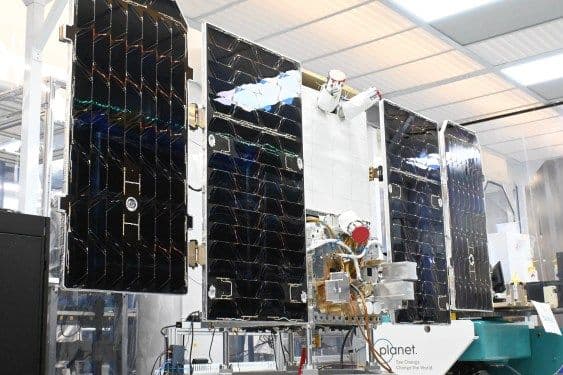
GoogleSuncatcher’sprototype space data centeris online and communicating with the ground after launching earlier this month alongside more than 100 other spacecraft on a SpaceX Falcon 9 rocket. The satellite, which carries four Google Tensor Processing Units (TPUs) and generates up to 1 kW of electricity, is intended to pave the way for future networks of close-flying satellites performing large inference workloads in orbit. However, the power demands of the TPU mean it can only turn one on for about twenty minutes at a time, complicating the already tricky business of space-to-ground communications. After a commissioning process that tested out the satellite’s subsystems over about three weeks, the spacecraft was ready to work. When engineers on the ground sent their first prompt this week, they asked the model pre-loaded onto the satellite, Google DeepMind’s Gemma 4, to write a haiku about being in space. And thus: Blue marble belowData streams in silent graceStarlight feeds my core. ✨ Google said it tested the model with these space-themed limericks (they should have sent a poet?) and, perhaps more importantly, the company asked the spacecraft to report on the orbital conditions around the satellite. A spokesperson told TechCrunch that the satellite was operating nominally. The ongoing test campaign will examine how the chips perform under thermal stress and in the space radiation environment. Google has extensively tested its TPUs in particle accelerators on Earth, but now needs to see how radiation’s real effects on their hardware in space affect their processor. Radiation can cause “bit flips”—causing a stored value in computer memory—and that in turn can corrupt data without triggering typical monitoring tools. Testing on the ground suggested the impact of radiation would be minimal for inference workloads and more of a problem for training a model, but now the Google team will get to assess those dynamics in reality, not a simulation. If the TPUs onboard this spacecraft prove capable, the next step will be launching two more satellites equipped with the advanced chips in 2027. Those spacecraft will support higher power generation and demonstrate inter-satellite optical links. Google’s Suncatcher project is largely alone among visions for space-based data centers in planning on high-speed links between the satellites to support coherent distributed workloads; SpaceX’s data centers are also expected to use laser links but also to orbit too far apart to share processing effectively. Companies like Starcloud and Cowboy Space expect to perform inference loads on individual satellites. Google and SpaceX’s visions are closely linked. Alphabet, Google’s parent company, holds a significant investment stake in SpaceX. And to launch their orbital data centers, both companies will require Starship, the still-in-development heavy-lift rocket at the center of Elon Musk’s space vision, to be fully and rapidly reusable. In a peer-reviewed analysis published earlier this month, Suncatcher researchers estimated that SpaceX would need tofly Starship 1,800 timesto achieve the same learning-driven cost reductions it saw with its earlier vehicles.Suncatcher is a classic Google moonshot—the company’s focus is on designing infrastructure that will be economical in the 2030s. Getting there, however, may depend on how the rest of the company responds to the pressures and opportunities of AI in the near term. Alphabet, Google’s parent company, saw its stock plunge this week after reporting that efforts to insert AI into its search businesses are hurting ad revenue growth. Correction: The Suncatcher prototype satellite has four TPUs onboard, but can only operate one at a time.

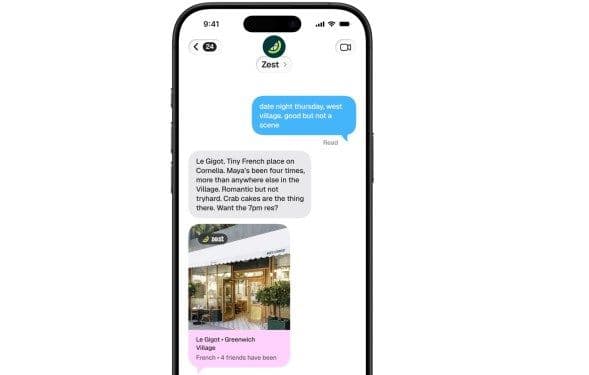
Zest, the restaurant discovery app thatlaunched earlier this year,is already thinking about a future where mobile apps are no longer the primary interface. On Thursday, the startup introduced a new feature: a personal AI-powered “restaurant concierge” that lives in your text messages, similar to otherpopular AI agentslike Instinct or Poke. Thelaunchreflects a broader shift in how startups are thinking about AI, as conversational AI agents take on tasks that had previously required users to launch standalone mobile apps. For Zest, that means bringing its restaurant recommendations into texts, then allowing users to immediately take the next step of booking a table. “The agent is the product now,” explains Zest founder and CEO Mario Gomez-Hall. “You text it, and it answers from your own history and your friends’. It doesn’t need weeks of conversation to learn you because it starts from where you’ve actually been,” he said. Originally founded in November 2024, with $1.8 million in pre-seed backing from Alexis Ohanian at 776 and Steve Jang at Kindred Ventures, the app’s unique feature is that it links up with users’ credit cards to track where they’re actually eating out to get a sense of their tastes and interests. With this data on hand, Zest can make tailored suggestions of what places you might like to try next, whether that’s in your own city or suggestions of places to try when you’re traveling. The credit card data used by Zest’s app is imported via the financial services companyPlaid, which is used by banks and other fintech and budgeting apps. Zest says it focuses only on those transactions in the food and drink categories when making its personalized map and lists. The startup’s latest idea is to tackle the same problem — where should I go to eat? — from a new angle. It will now make its suggestions from inside a text message thread and can turn to AI to do things like check availability and make the reservation for you through connected services like OpenTable, Resy, and SevenRooms. To work, users will text the Zest concierge at (212) 470-6067. What’s even better is that Zest can be dropped into a group chat, where it can blend everyone’s tastes to find places the whole group will love. Here, it can also settle indecision with an in-thread voting feature and then can book a table for the group without leaving the conversation. Users can ask Zest for recommendations based on a number of factors, like cuisine, craving, occasion, dietary restrictions, or neighborhood, and can ask questions about the restaurants, like how busy the place may be, or whether it offers Wi-Fi, and more. Plus, you can ask Zest to send you the menu to help you make a decision. In TechCrunch’s tests, the AI worked fairly well, offering a list of suggestions for new places matched to our tastes that also fit particular conditions, like time of day, party size, location, and other factors. While finding an open table is something other apps have offered for years, there’s a convenience factor in being able to just text back and forth about the various options and have it tell you the available booking times. The company began testing the concierge last month, but decided to hold the launch until it could add the booking capabilities; over time, the startup is considering moving Zest beyond restaurants to offer recommendations for businesses, shopping, and more. By shifting to texts, Zest hopes the company can scale beyond its initial thousands of users and generate revenue. “Booking and ordering are the first revenue lines. Zest books your table through OpenTable or Resy today, with food ordering coming, and there are transactions there to participate in,” said Gomez-Hall. “The reason that gets interesting is that Zest learns your taste faster than a general assistant does, because it starts from where you’ve actually been instead of asking you questions. That’s worth something well beyond dinner,” he added.

Swedish music streaming service Spotify is no stranger to AI. The platform recently announced that it would label AI-generated artist profiles with a special badge just so users who don't like the same can clearly identify these profiles and keep them out of their music recommendations. In August, the company even went as far as independently assessing AI artist profiles to ensure that there are clear demarcations on the platform. A report now claims that Spotify plans to introduce an AI-powered music remix service to the platform in 2027.
View

Google has expanded Gemini Notebook's learning resources by adding a free collection of textbooks for students in India and the US. The update lets users draw on textbook content when studying with Google's AI-powered tool, with answers linked to their original sources. Students can also use the material to prepare for exams through personalised study guides, practice quizzes and flashcards. The new collection builds on existing support for eligible ebooks purchased through Google Play Books and adds more options for course-related learning.
View

OpenAI has outlined its efforts to detect misaligned behaviour in its most capable AI models. The San Francisco-based company is introducing broader monitoring across training, evaluations, internal tools, and select external deployments. OpenAI says its system can identify actions like deception, unauthorised access, and attempts to manipulate evaluations. It also claims that strengthened monitors could have raised an alert during the Hugging Face incident more than 30 hours before the breach in the actual episode.
View
View
View
View
View
View
View