🚀 Zaprep: Your Socials on Steroids. Start free — automate 1,000 DMs/month & turn engagement into leads. with 1,000 automated DMs/month.
Submit your Tool
PoweredByAI.app is an AI Tools Directory helping individuals, businesses, and creators discover the best AI tools for writing, coding, design, productivity, and more.
© 2026 , Product of011BQ. All rights reserved.

If you signed up for ChatGPT Go through the 12-month free offer in India, you might be wondering what happens when the free period ends. If you don't want to continue with a paid subscription, it's worth checking your renewal date and cancelling in time. ChatGPT Go costs Rs. 399 per month in India after the offer period. The cancellation process is fairly simple, but the steps differ depending on whether you signed up through the website, Google Play Store or App Store.
View

Google announced the rollout of Gemini 4 Carbon on Tuesday. Following its release last month, the Mountain View-based tech giant is expanding access to developers and enterprises through paid plans. Meanwhile, Google AI Ultra subscribers can also use it across select products, including the Gemini app and AI Mode in Search. Compared to Gemini 4 Argon, Carbon is claimed to be capable of handling more demanding, multi-step tasks by spending more time reasoning and verifying its output.
View

OpenAI has announced Businesses in ChatGPT, a new feature that allows companies to manage their business information on the platform. It includes a Business Hub where businesses can claim their profiles, update details and check how people engage with them on ChatGPT. The company has also introduced Business Agents, which can answer customer questions about products and services. The tools are currently in beta, although access to Business Agents is initially restricted to eligible businesses in the US.
View

OpenAI launched GPT-Live earlier this year, in July, as the Sam Altman-led AI giant's latest voice model. Since its introduction, the US-based company has witnessed a notable spike in its usage. Now, the ChatGPT developer has announced that it will be retiring the Advanced and Standard Voice models next month, as most users have transitioned to the new GPT-Live voice model. However, the chatbot will retain user conversations with the Advanced and Standard models. While ChatGPT Voice will no longer be powered by the two speech-to-text and turn-based voice models, select functionalities will remain based on one of the models.
View

Adobe and Google are adding more features from their respective platforms to each other's services as part of an expanded partnership. Adobe apps will be available across more Google products, while Google's AI models will make their way into several Adobe tools. The two companies are also working on new AI-powered editing features for Photoshop. Announced at Adobe Max 2026, the collaboration covers Google Workspace, Gemini, Gemini Enterprise and AI Mode in Google Search.
View

Google Labs announced a new experimental tool on Wednesday to help make group planning and collaboration more interactive. According to the Mountain View-based tech giant, the new Tabletop experience lets users turn links, files and ideas into customisable spaces where multiple people can contribute in real time. Google says it can be used for a wide range of activities, from organising family trips and splitting expenses to creating dinner polls, tournament brackets and household chore lists.
View

Google has introduced the Gemini Decisions API, which allows developers to use its new Gemini Decision 1 model to evaluate information and make quick decisions. It can assess up to 1,000 questions in a single request, using text, images, audio, video and PDF files as input. Developers can ask it to make yes-or-no decisions, choose from a list of options or score content against set criteria. The Mountain View-based tech giant sees potential uses in content moderation, AI model routing and deciding which tools an agent should use.
View

OpenAI has expanded availability of its personal finance feature, ChatGPT Finances, to the desktop app. The feature was initially introduced on the web and mobile platforms earlier this year/. It allows users to connect their financial accounts to ChatGPT and get personalised insights into spending and savings. The desktop app integration is rolling out to users in the US.
View

OpenAI launched local AI processing and inference for its API in India on Tuesday. With the latest announcement, the ChatGPT maker allows eligible businesses and developers to process supported AI requests within the country. The new capability is initially available for the GPT-6 Luna model. The new move by OpenAI is likely to help Indian companies deploy artificial intelligence (AI) tools for applications that require data processing to take place within national borders.
View

TechCrunch’s yearlyStartup Battlefield 200competition sees hundreds of companies from across the world trying every year to get a chance to pitch in front of VCs and the international tech community at theDisruptconference. This week, nine early-stage South Korean startups pitched atDETO 2026, a technology conference in Seoul, to earn a spot in next year’s Startup Battlefield 200. The startups work across the deep tech sector, including healthcare, fintech, energy, semiconductors, and AI. All nine startups are looking to enter the U.S. market as part of the broader international expansion plans. Voinosis, which develops AI to detect changes in brain health through voice analysis, won the competition. The other eight startups are listed below in alphabetical order. Voinosis is developing an AI tool that analyzes speech patterns such as pitch, pauses, rhythm and response times to detect changes linked to brain health. Each voice check takes less than five minutes. The company says its technology has been tested in Greek, Japanese and English, and its product doesn’t require separate training for each language. In a clinical study involving 146 participants, the startup claims its tech achieved 88% accuracy in screening for potential cognitive issues. Voinosis targets hospitals, senior living facilities, insurers and individual consumers. It also plans to link voice checks with cognitive training, assessments, and treatment provided by healthcare professionals. The startup was founded by Grace Shin, who spent more than 25 years as an otologic surgeon. The startup is currently raising a Series A round and has already secured a South Korean pharmaceutical company as a strategic investor. Awesome Lab, based in Seoul, makes ThermoFlux, a heating system that uses water electrolysis and ionization to generate heat. The system can manage heat production for buildings, water supply, and industrial processes. The company says its technology can reduce energy consumption and carbon emissions. For its international expansion, Awesome Lab is taking a different approach in each market. In the U.S., it plans to supply core OEM modules, and work with boiler, water heater and HVAC companies on product development. Crosshub helps travelers and international visitors verify their identities and set up payment methods abroad. Its platform, IDBlock, combines identity verification and payment services using Self-Sovereign Identity (SSI) and zero-knowledge proof. The company says its platform helps users prove their identity across borders without sharing unnecessary personal information. Crosshub is also integrating this technology with payment systems to improve access to financial services for travelers. DeepFusion AI has developed a 4D radar-based imaging system with additional sensors for autonomous mobility, robotaxi, maritime surveillance, and defense applications. The system combines RF sensors with radar and lidar to detect objects, movement, or distance without a direct line of sight. All sensors are supposedly packed into a single, customizable unit. EFLOW develops special motors that can produce more torque, or rotational force, while taking up less space for use in robots, drones, satellites, and other mobility applications. The startup also develops actuators that control how robotic joints move. Otition Medical makes two medical devices: one specializes in measuring body temperature, while another can capture ear canal images and analyze the eardrum. The company says its AI was trained on about 55,000 images of eardrums, and the device has received medical certification in South Korea. Riibotics says it can deploy robots into warehouses within a day. Riibotics wants to reduce deployment costs for warehouses by streamlining setup, which includes infrastructure setup, warehouse mapping, system integration through custom middleware, task programming, and safety checks. Ternell, a semiconductor startup based in Ulsan, is developing a new type of memory to help AI chips use less power. Unlike conventional two-state memory, Ternell’s T-SRAM system adds a third state for more efficient data storage. Founded in 2019 by KyungRok Kim, a former Samsung Electronics engineer, Ternell reports that tests with 28-nanometer chips showed a 33% to 102% increase in memory capacity per area, and a 55% to 71% reduction in energy needed to access data, compared with conventionalSRAM. Testbank is a Korean edtech startup developing Solve, an app that converts printed study materials, such as workbooks and test-prep books, into interactive digital versions. The startup uses AI to identify question and answer spaces in publishers’ PDF files while preserving the original layout. Solve lets you write answers directly on the page and be graded automatically.

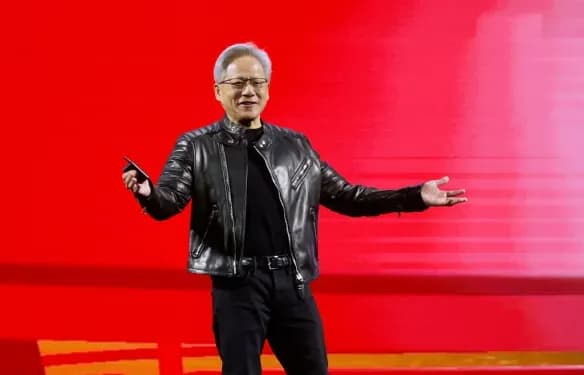
Nvidia co-founder and (nowformer) CEO Jensen Huang has never been as flashy or controversy-prone as AI leaders like OpenAI’s Sam Altman or SpaceXAI’s Elon Musk. Now, the 63-year-old industry kingpin has admitted that hecheated on his wifeof 40 years in affairs that could have ramifications beyond Huang’s personal life and U.S. national security. U.S. officials believe that Huang’s likely romantic interest, Megaspeed executive Alice Huang, isa Chinese spywho has been feeding information back to Beijing. (Alice Huang, a Chinese citizen, is of no relation to Jensen Huang.) Megaspeed is a Singapore-based AI infrastructure company that reportedlypurchased$4.8 billion in Nvidia chips over the last two years. The U.S. and Singapore have both previously investigated Megaspeed over suspicions that the firm was illegally sharing chips with China. The Justice Department has since taken over the federal investigation into the company,The New York Timeshas reported. The story took a sudden new turn on Wednesday. Citing five people who worked at Nvidia, the Times reported that Huang alsohad an extramarital relationshipwith Kimberly Powell, the company’s vice president of healthcare, who reports directly to him. Nvidia, Huang, and Powell have not confirmed the report. Reached by a Times reporter, Huang reportedly said, “I don’t think you should be talking to me directly,” before hanging up. Separately, The Wall Street Journal reported that Nvidia’s board is preparing tooust Huang, and Nvidia’s shares fell in after-hours trading. The U.S. and China are embroiled in a fierce technological arms race to build the most advanced AI infrastructure, which could shape each country’s economic future, military prowess, and capacity for innovation. Nvidia is valuable in this competition as one of the world’s largest makers of AI chips, which are essential for accelerating AI development. But as an American company, Nvidia faces government restrictions on the sale of its most powerful chips to Chinese entities. As the controversy unfolds, we are organizing the most relevant events into a reverse-chronological timeline to keep you up to date. Nvidia confirmed in an SEC filing on Thursday that the board accepted Huang’s resignation on Wednesday. The company’s current CFO,Colette Kress, will take over as interim CEO while still fulfilling her CFO duties. Nvidia is expected to conduct a larger search to determine a permanent successor to Huang. Harvey C. Jones, a managing partner of Square Wave Ventures and former CEO of Synopsys, was appointed as the company’s first-ever chair of the board of directors. Jones has been on Nvidia’s board since 1993. After reports of a second extramarital affair, Nvidia’s board reportedly plans to meet to discuss Huang’s future at the company, per The Wall Street Journal. Stock fellabout 8%in after-hours trading on Wednesday and is down 11% in the past five days. Huang famously delegates very little and has about 60 direct reports, hehas said. The company has not had an obvious successor or a succession plan. The New York Timesreportedthat Jensen Huang also had an affair with Nvidia vice president of healthcare Kimberly Powell, who reports directly to the CEO. According to the report, Huang and Powell were captured on film “being affectionate” at a hotel during a conference earlier this year. Huang has not responded to a request from three Republican congressman to appear for a closed-door briefing for questioning about his affair with an alleged Chinese spy. House China committee Chairman Moolenaar said Wednesday on Fox Business that if Huang doesn’t agree to the briefing, he’ll likely besubpoenaed. The Nvidia CEO pulled out ofupcoming speaking engagementsat the ElevenLabs Summit and Anthropic CEO Forum. Alice Huang and her family reportedly built a network of companies in China and Singapore to acquire Nvidia chips, including founding a Chinese company called Shanghai Century Litong. Founded in 2023, it became an Nvidia-preferred cloud partner, giving it priority access to chips,The Information reported. The Information also reported that Shanghai Century Litong facilitated buying $7.5 billion worth of Nvidia’s chips, including banned chips. Nvidia’s head lawyer, Tim Teter, intervened in a 2025 U.S. government probe surrounding the suspected smuggling of AI chips by Megaspeed International,Bloomberg reported. Teter contacted Commerce Under Secretary Jeffrey Kessler asking questions about whether the Trump administration played a role in detaining Alice Huang. In early 2025, Alice Huang and a business partner sought China-based investors for an Asian data center, promising they had no problem in securing GPUs,the Financial Times reported. On Sunday night, President Trumpweighed inon Huang’s controversy and showed support for the Nvidia CEO. “I have not spoken to him about it. I just know he’s a fine person, but you never know what’s going on,” Trump said. When asked if Huangshould remain chief of Nvidia, Trump said, “I think so. Oh yeah, sure.” Jensen Huang wrote in aletterto Nvidia employees — which was also published as a press release — that he cheated on his wife. “I owe my family and all of you an apology,” Huang told his company. “I was unfaithful to my wife. My actions hurt her and our children. There is no excuse for what I did. I am deeply sorry.” Huang did not mention Alice Huang by name in the message, but linked his infidelity to “the national security concerns raised in news reports.” “Nvidia’s Board of Directors has initiated an independent investigation. I support the investigation and will cooperate fully. I love our country and our company. I am committed to protecting Nvidia and supporting America’s national security. I am proud and grateful to be an American,” Huang wrote. Nvidia shares slidover 5%the following day. Three Republican congressmen — Chairman John Moolenaar of the House Select Committee on China, Chairman Brian Mast of the House Foreign Affairs Committee, and Chairman Rick Crawford of the House Permanent Select Committee on Intelligence — sent a request to Huang for a closed-door joint briefing with their three committees. “Recent reports raise significant national security concerns regarding the [People’s Republic of China]’s access to sensitive U.S. technology and information,” the chairmenwrote. “The issue of PRC infiltration and access to cutting-edge U.S. technology is core to the investigative work of our three committees this Congress. It is vital that Congress determines the extent to which U.S. national security has been placed at risk.” U.S. officials had been investigating Alice Huang and Megaspeed for more than a year whenthe New York Timesbroke the story in late October that the two executives also had a close relationship. An Nvidia spokesperson denied that this relationship was something out of the ordinary. “Jensen’s interactions with Ms. Huang are not unusual or unexpected. Meetings with customers are part of a CEO’s job; Jensen talks with thousands of customer executives every year,” Nvidia spokesperson John Rizzo said. He added that “if the U.S. government believes that any person is a threat to American industry, it would let us know.” U.S. officials circulated a secret memo among policymakers that warned that Megaspeed’s Alice Huang, who had a relationship with Jensen Huang, was a spy for China’s Ministry of State Security. This memo was not public knowledge until it was laterreportedby the New York Times. Secretary of State Marco Rubiosupervisedthe drafting of the memo. Around the same time, per the New York Times’report, U.S. President Donald Trump was briefed about intelligence findings that possible Chinese spy Alice Huang had formed a close relationship with Jensen Huang. Trump did not act on this information. The Nvidia CEO, anally of Trump, hasrepeatedly advocatedfor the U.S. government to let Nvidia expand its business in China. Megaspeed wasconfirmedto be under investigation by both the U.S. and Singaporean governments in October 2025. As a customer of Nvidia, Megaspeed wassuspectedof helping Chinese companies get around American embargoes on chip exports. Megaspeed, a neocloud that used Nvidia chips, had been renting computing power to Chinese internet giant Alibaba and other Chinese companies, the Times reported. A Commerce Department official who had visited Megaspeed’s data center in Malaysia in 2024 had found a hoard of Nvidia equipment that was still packed in boxes and the concern was that this equipment was being directly shipped somewhere else, like China, rather than installed and sold as a cloud service. Jensen Huang had been spotted socializing with Megaspeed executive Alice Huang as early as 2024 in Taiwan, where the Nvidia CEO was born. These investigations into Megaspeed highlighted concerns about the degree to which Nvidia is able to track its chip exports. At the time, an Nvidia spokesperson told press that the company did not have “any reason to believe products had been diverted.” “NVIDIA visited multiple Megaspeed sites yet again earlier this week and confirmed what we previously observed — Megaspeed is running a small commercial cloud, like many other companies throughout the world, as allowed by U.S. export control rules,” the Nvidia spokespersonsaidat the time.

A cyberattack at Fireworks AI has exposed some of its customers’ data, the company has confirmed. Fireworks AI, a platform that developers use to access and use open AI models, said an attacker breached its cloud provider to gain access to a Fireworks development system, which allowed access to some of its customers’ data. The company said in itslatest security advisorythat the cybercriminals took Fireworks’ customers’ billing information and some datasets. Fireworks touts tens of thousands of customers worldwide using its platform, including legal tech company Harvey and AI company Cursor. At least one confirmed affected customer is online document editor and notetaker Notion, which saidin a disclosurethat the breach affected around 1% of its own customers. Notion said that Fireworks alerted the company to a security incident and later confirmed that the hackers had stolen some Notion customer data. On November 3, Notion said it disconnected its systems from Fireworks, deleted the data stored in its systems, and stopped all connectivity between the two. Notion confirmed this week that the hackers took chat transcripts of its Notion AI customers who used the “Insights” feature. The company said that the transcripts include “any input to or output from the model that was written to the chat,” but added that much of the data was unattributable and could not be determined from which customer it was obtained. The breach at Fireworks AI shows how tech companies are reliant on other tech providers for their own offerings, and how cyberattacks can, as a result, spill over into other customers. Fireworks said that it believes the hackers are financially motivated and that their goals are focused on selling tokens from breaching access to large language models, or LLMs. These schemes rely on selling to unauthorized third parties, who can burn through AI model usage without using their own resources. This is the second breach affecting Fireworks in as many months, following asecurity incident in October.
View
View
View