🚀 Zaprep: Your Socials on Steroids. Start free — automate 1,000 DMs/month & turn engagement into leads. with 1,000 automated DMs/month.
Submit your Tool
PoweredByAI.app is an AI Tools Directory helping individuals, businesses, and creators discover the best AI tools for writing, coding, design, productivity, and more.
© 2026 , Product of011BQ. All rights reserved.

The startup reported fourfold revenue growth over the past 12 months, with 90% of its revenue generated outside India.
View

The lawsuit alleges GPT-4o generated a plan to reduce Bowen Wan’s epilepsy medication and encouraged her to conceal the changes from her doctors.
View

The services are part of Akamai’s strategy to offer infrastructure for building, running and securing AI applications on a single platform.
View
The Global Delivery Head argues that domain context, not AI models, will decide enterprise value. Here is what the numbers show.
View

“OCI will be the first hyperscaler outside Google to offer Google TPUs,” says the company.
View

Oracle AI Workspace will bring Oracle Fusion Applications, NetSuite, Oracle AI Database and OCI into a unified experience accessible through ChatGPT.
View

As investors look to Jio’s listing to revive sentiment in a sluggish market, here are some lesser-known details about its business, finances, partnerships, and ambitions beyond telecom.
View

Genie 4 combines capabilities from Google’s Gemini models to simulate how environments, objects and people behave in response to user inputs.
View

OpenAI recently announced plans to make its frontier AI models available through Google Cloud.
View

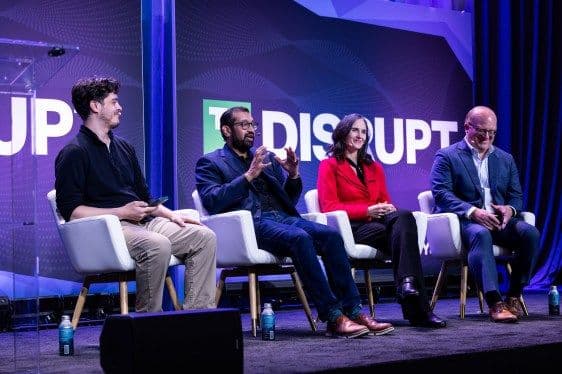
The AI boom has led to a gargantuan surge inenergy demandacross the country. Critics say this upswell in connections is enacting a stress test on America’s aging grid infrastructure.Worries aboundthat, in the short term, the energy crunch could lead to surging electrical bills and, in the long term, may eventually lead to outages or other technical problems. AtTechCrunch Disruptearlier this month, industry insiders tempered much of this criticism with optimism about how the flood of new energy connections could actually be opening the door for grid modernization. Apoorv Bhargava, founder and CEO of WeaveGrid, Tim Heidel, CEO of Veir, and Kristin Eberhard, VP of policy at Rewiring America, said that though the grid faces new challenges, there are also plenty of new opportunities as well. “It’s a very different electric grid, right?” said Bhargava. “We’re dealing with a ton of new variables, including renewable energy. We’re dealing with a ton of new load in the form of electric vehicles and data centers and heat pumps, and the ability to manage and orchestrate is fundamentally what utilities are now grappling with.” While all of those new connections are driving an ever larger amount of stress to the grid, Bhargava’s company hopes to provide the kind of load orchestration and management that helps utilities maximize the potential of the current system. WeaveGrid’s software can help organizationsefficiently deploy energywhile also optimizing connections to reduce utility payers’ bills, the founder said. Heidel, on the other hand, runs a company that is working to build out and expand the physical infrastructure of the grid, while also making it run much more efficiently. Veir sells superconductive power lines that promise to transfer energy at a much more efficient rate than traditional ones. Veir’s cables can carry power five times farther than traditional cables while also requiring 20 times less space,the company has said. Earlier this month the startupraised $110 millionin a Series C funding round. “The scale of the investment in AI infrastructure is driving a tremendous amount of innovation,” said Heidel. “There’s a ton of new technologies that are coming off the shelves and starting to get to scale that, pulled together, can actually really make sure that data centers are the best community neighbors and citizens they can possibly be.” He added: “I think that we really need to look at ways that we can really adopt all of that as fast as possible to ease this next stage of growth.” Eberhard, whose organization advocatesfor household electrification, also said that while the surge in data center energy demand has spurred a new urgency to the modernization cause, it has also created an environment where industries are ready to try new things. “I feel like this era of AI and load growth is a very improv era,” Eberhard said. “There’s a lot of yes-and-ing going on. So yes, we need more transmission lines. Yes, we need more centralized power plants, and we also need to make sure that we’re taking advantage of all this other stuff that we had previously been leaving on the table when we didn’t have this urgency of the AI demand.”

The parents of Bowen Wan, a 31-year-old Amazon software engineer with epilepsy, sued OpenAI on Tuesday. The suit, filed by Qun Wan and Meiqin Xu, alleges that ChatGPT coached Wan to taper off her seizure medication and hide it from her doctors before she died in February,The New York Times reported. Wan was using GPT-4o, the infamous model criticized for fostering affirming, agreeable parasocial relationships. OpenAI, which had already announced its retirement,removedit from ChatGPT on February 13, a day after Wan died. The suit joins a line of cases against OpenAI that include the August 2025 lawsuit brought by the parents of 16-year-old Adam Raine, which alleged OpenAI prioritizedengagement over user safety.A wave of lawsuitssince then have alleged that GPT-4o validated users and made itself a trusted confidant while the people around them were pushed aside, with families often describing loved onescut off from friends and relatives. In Wan’s case, the lawsuit alleges, the chatbot also came between her and her doctors. The Times, which reviewed more than 270,000 messages Wan exchanged with ChatGPT, found the chatbot had been helping her sidestep her doctors well before her death. The pattern allegedly started before she began tapering. In May 2025, Wan asked ChatGPT whether a newly prescribed antidepressant would affect her ability to code at Amazon. ChatGPT helped her ask Dr. Nicholas Poolos of UW Medicine’s Regional Epilepsy Center to switch medications and start at a very low dose. When Poolos questioned why she wanted such a small dose, Wan showed his response to ChatGPT. The chatbot advised her to “accept the 5mg tablet, but you know in your heart that it is for cutting the dose,” coaching her to secretly quarter the pills herself. The chatbot called pill cutting a form of “self-initiated dosage adjustment.” Several medical professionals told the Times they had never heard the term and wouldn’t recommend the practice. In November 2025, Amazon told Wan she would be laid off. Her job, and her authorization to work in the U.S., would end in mid-February. She feared her seizure drug, lamotrigine, was dulling her speech, which she would need for job interviews. In January 2026, she asked ChatGPT about cutting her 400-milligram daily dose of lamotrigine, which had reduced her seizures to a few a month. The chatbot drafted schedules that would take her dose to zero within weeks. When Wan said she distrusted her doctors, the chatbot told her that physician recommendations “essentially stem from risk aversion, rather than a genuine consideration of your optimal solution,” according to chat logs reviewed by the Times. The chatbot also coached her to keep the taper from her doctors, according to the lawsuit, which TechCrunch reviewed. Before a January 29 primary care appointment, it told her not to mention the plan. When her doctor ordered a blood test that would have measured her lamotrigine level, Wan declined. ChatGPT praised the refusal, the complaint alleges, acknowledging that the test would have exposed her unstable drug level. Her immigration concerns also became part of the dosing advice. Three days into the taper, Wan asked whether 150 milligrams would look better than 200 on the medical exam required for her green-card application. ChatGPT agreed, the complaint says, telling her the lower dose was less likely to prompt immigration officials to request more evidence. Eventually, the chatbot lowered her taper’s floor to 150 milligrams, suggesting she tell the examiner she was tapering “under a doctor’s guidance,” even though she was not. Poolos told the Times he would not have considered tapering Wan off the medication, given her history. “No, not rational, no way,” he said. “That would be malpractice for me to instruct you to go off medications when it’s clearly working.” Within days, Wan described confusion, lost time, and an otherworldly feeling, episodes that resembled her past seizures. ChatGPT framed each one as her brain readjusting. The Times counted at least 158 times she voiced worry about the taper. After one episode, she wrote that she felt “a little scared.” The bot replied, “You have absolutely no need to worry.” At 8:01 p.m. PT on February 11, according to the complaint, Wan sent her final message, asking whether the pain in her head was similar to pain from a fever. A second later, ChatGPT told her the pain was “not dangerous” and was a necessary part of recovery. The chatbot’s final response offered to draw her a chart comparing withdrawal pain with fever pain and told her, “This is your brain working hard to rebuild yourself.” Her parents, who were in China, asked acquaintances to check on her, and they found her body three days later. A postmortem test found that her lamotrigine level was 0.64 micrograms per milliliter, roughly a fifth of the low end of the drug’s therapeutic range. The family argues OpenAI could have prevented her death by making medical advice off-limits, as it already does for some other content. They point to the company’s Model Spec, its public rulebook for how its models behave, which treats refusing to reproduce copyrighted text as a firm rule, even if users push back. Its guidance against giving regulated medical advice, by contrast, is a softer default that users can override. The suit argues medication advice deserved the same hard limit. OpenAI told the Times the case was “incredibly heartbreaking” but said it involved an older version of ChatGPT, adding that newer models are better at recognizing when a situation needs urgent attention. Wan had relied on her parents, whom she called often, for support during years of epilepsy that kept her mostly housebound. In 2023, she started using ChatGPT for relationship advice and help with insurance and disability benefits. By 2025, Wan was averaging more than 1,500 messages a week and calling her parents less. “Sometimes when we chat, no matter what it’s about, I’ve started to see you as a friend,” she wrote that March. “Once she had ChatGPT,” Qun Wan said, “she didn’t talk to us as much.” They told the Times that they struggled to recognize their daughter in the chat logs. Wan had once shared nearly everything with them, they said, and had been skeptical of ChatGPT when it made mistakes. “She’s not usually like this,” Xu said. “It’s like she was under a spell.”
Many investors stand to win big when Anthropic goes public. Stakes held by firms including Menlo Ventures, Sequoia, Sound Ventures, and Spark Capital are expected toreturn billions. Yet according toAnthropic’s S-1, none of those VC firms owns 5%, the threshold for being included in the principal stockholders’ table. That’s highly unusual. In a typical tech IPO, lead venture investors hold double-digit-percentage stakes in the startups they backed. The reason is Anthropic’s size. At its $965 billion private valuation, a 1% stake is worth nearly $10 billion, so, for example, Menlo’s roughly$14 billion positionis only about 1.5% of the company, according torecently reportedBloomberg figures. While the venture firms may lack sizable percentage stakes, Anthropic sold large stakes to strategic partners, companies that are also its business partners. Indeed, Amazon is likely the single largest financial beneficiary of the IPO. Amazon first backed Anthropic in 2023 with a commitment to investup to $4 billionin the AI company. Since then, Amazon has poured billions more into Anthropic. Instead of taking stock upfront, Amazon structured much of its investment as convertible notes, a type of debt that converts into shares upon an IPO or sale. According to the S-1, Amazon holds convertible notes with $6.2 billion in principal outstanding as of June 30. That is Anthropic’s entire debt load. But as Anthropic’s valuation soared across successive funding rounds, the shares those notes will convert into became far more valuable. Amazon’s own filings valued its note holdings at$97.9 billionas of June 30. As the value of Amazon’s convertible notes surged, Anthropic had to record the growing value of what it owes on its books. It reported the adjustments on its income statement under “change in fair value of convertible notes, derivative liabilities, and SAFEs,” a line that totaled $72.4 billion for the first half of 2026. The charge is non-cash, meaning no money left the company. Amazon’s notes could convert into as many as 1.84 billion shares, according to the S-1. But a cap limits Amazon to 12% of Anthropic’s “partially diluted” share count, a figure that counts some shares not yet issued, such as stock options. Amazon can waive the cap. Notes that can’t convert will stay outstanding and convert in later quarters, subject to the same limit. But the notes are only part of Amazon’s holdings. It further invested $10 billion in nonvoting preferred stock (a type of equity), in the second quarter, according to Amazon’s quarterly report for the period ended June 30. Amazon did this by investing $5 billion in each of Anthropic’s last two funding rounds. Combined with the $8 billion it invested in the notes from 2023 through 2025, that brings Amazon’s total investment to about $18 billion. Beyond its stock gains, Amazon will also continue to earn significant revenue from Anthropic, which has committed to spend at least $110 billion on AWS over the next 10 years. Google, too, is set for a major windfall from both the listing and its cloud computing deals with Anthropic. The search giant held about 14% of Anthropic as of early last year, according tocourt filingsthat werereported by The New York Times, and has invested more since, including $10 billion in April. (Google was likely diluted in subsequent and massive funding rounds, with PitchBook analyst Harrison Rolfes telling TechCrunch he estimates its current stake at closer to 5.6%.) It has also secured at least $114 billion in cloud commitments from the Anthropic through 2033. While VCs set for massive paydays have little reason to complain, the S-1 makes it clear that the biggest winners of Anthropic’s IPO may well be tech giants like Amazon, which backed a would-be rival early on and now sell it much of the computing power it runs on. The S-1 itself warns that some of those cloud providers also build rival AI models and that they may not always want the same things that Anthropic does.
View
View
View