





Is this your AI tool? Claim it today.
Verify ownership, manage your profile, and unlock growth features.
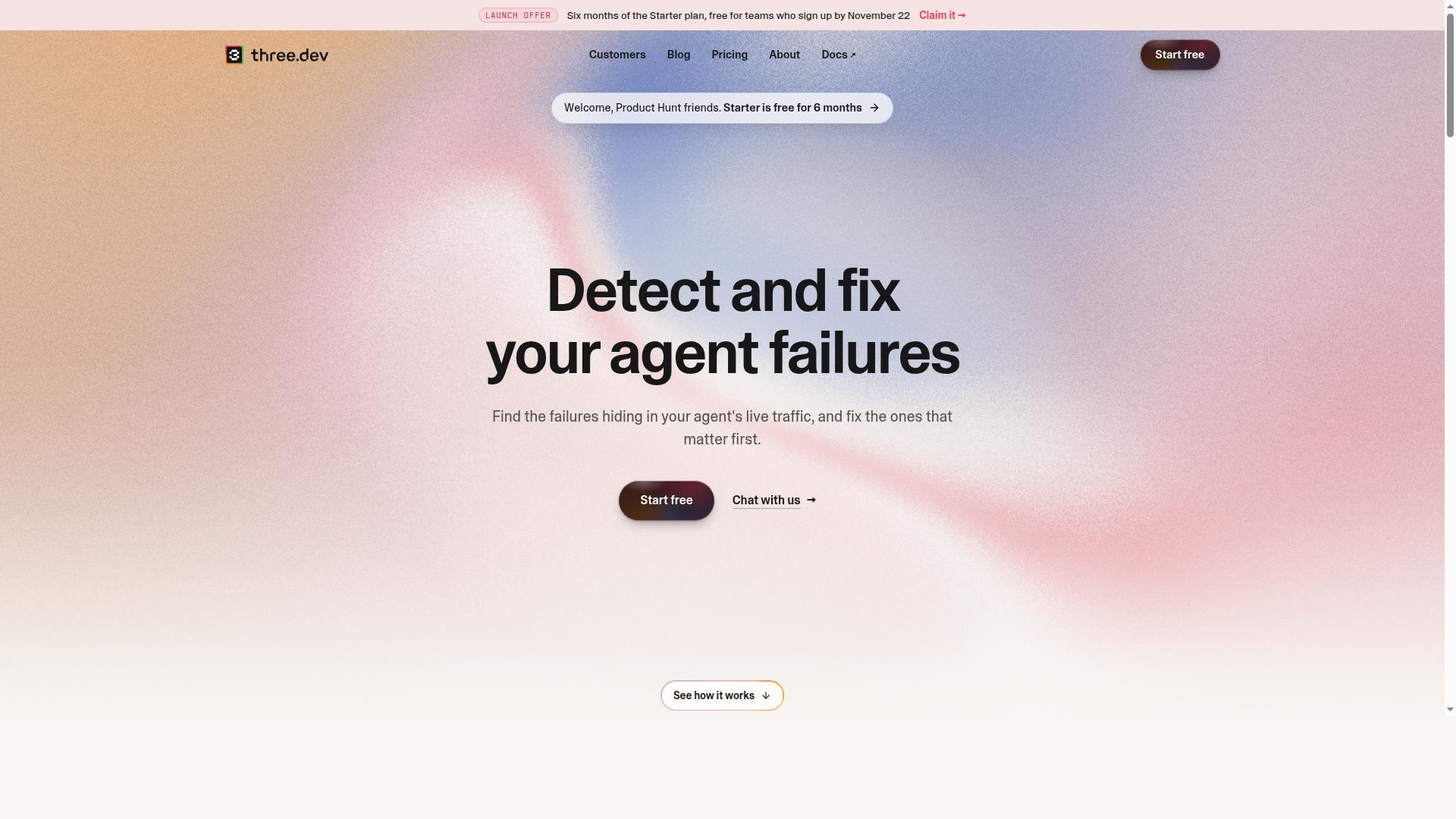
three.dev uniquely captures and analyzes live LLM traffic to detect AI agent failures before users notice, grouping issues by severity to help teams prioritize fixes efficiently. It’s an essential tool for AI developers and product teams aiming to maintain robust, reliable AI-driven features.

Description
Almost every team now runs AI in production, but few know how it behaves once real users show up. The failures are quiet: a wrong refund policy, a made-up order status. Nothing crashes, so you hear about it from your users. three.dev finds those failures in your live traffic on its own and ranks them by severity. Setup is one prompt to Claude Code, Cursor, or Codex. Then your coding agent gets what it needs to write the fix.
Detailed Description
three.dev is a specialized AI tool designed to monitor, analyze, and improve the performance of AI agents by capturing and evaluating their large language model (LLM) traffic in real time. Its core purpose is to help development teams detect failures in AI-driven features before end users encounter them, enabling proactive issue resolution and enhancing overall AI reliability. By recording every request made to an AI feature, three.dev provides a comprehensive view of how the AI behaves under live conditions, offering actionable insights into failure patterns and their impact. At the heart of three.dev’s capabilities is its ability to score each AI request and automatically group failures into distinct, named failure modes. These failure modes are then ranked by severity, allowing teams to prioritize the most critical issues that affect user experience or system functionality. This structured approach to failure detection helps teams focus their debugging and improvement efforts where they matter most. Additionally, three.dev supports fixing failures through an integrated MCP (Machine Code Programming) interface, streamlining the process of deploying fixes directly from the analysis platform. The tool excels in detecting failures from live AI agent traffic, providing an ongoing feedback loop that is essential for maintaining and scaling AI systems. It is particularly valuable for teams building AI agents or features that rely heavily on LLMs, such as chatbots, virtual assistants, or automated content generation tools. By continuously monitoring live traffic, three.dev ensures that subtle or emerging issues are caught early, reducing downtime and improving user satisfaction. three.dev is ideal for AI development teams, product managers, and quality assurance engineers who need detailed visibility into AI feature performance and failure causes. Use cases include monitoring conversational AI to identify misunderstood queries, tracking content generation errors, and prioritizing bug fixes in complex AI workflows. Its detailed failure mode classification and severity ranking make it a powerful tool for teams aiming to optimize AI reliability and user experience. Regarding pricing, three.dev offers a Starter plan that includes six months free for teams signing up by a specific promotional deadline, making it accessible for early adopters and smaller teams. While detailed pricing tiers are available on their website, the Starter plan provides a strong entry point for teams to begin leveraging the tool’s capabilities without immediate cost. This approach encourages adoption and experimentation before scaling up to paid plans with more advanced features or higher usage limits. Compared to alternatives, three.dev stands out by focusing specifically on live LLM traffic analysis and failure mode grouping, rather than generic error logging or manual monitoring. Its automated scoring and severity ranking system provide a unique prioritization framework that helps teams address the most impactful issues first. While other tools may offer general AI monitoring or logging, three.dev’s specialization in AI agent failure detection and integrated fixing workflow offers a more targeted and efficient solution. However, potential users should consider that three.dev’s effectiveness depends on integration with their existing AI infrastructure and may require some setup to capture and analyze traffic properly. Also, teams with very simple AI features or low traffic volumes might find the tool’s advanced failure mode grouping more than they need. Finally, as with any monitoring tool, ongoing maintenance and analysis are required to fully benefit from the insights provided. In summary, three.dev is a robust, purpose-built platform for teams looking to enhance the reliability and performance of AI agents by detecting, categorizing, and prioritizing failures in live LLM traffic. Its detailed failure analysis, severity ranking, and fixing capabilities make it an essential tool for AI product teams focused on delivering high-quality, dependable AI experiences.
Tool Features
- Records the LLM traffic of an AI feature
- Scores the requests and groups failures into named failure modes
- Ranks failures by severity
- Helps teams fix failures over MCP
- Detects failures in live AI agent traffic
- Prioritizes fixing the most important failures first
Description
three.dev uniquely captures and analyzes live LLM traffic to detect AI agent failures before users notice, grouping issues by severity to help teams prioritize fixes efficiently. It’s an essential tool for AI developers and product teams aiming to maintain robust, reliable AI-driven features.
Almost every team now runs AI in production, but few know how it behaves once real users show up. The failures are quiet: a wrong refund policy, a made-up order status. Nothing crashes, so you hear about it from your users. three.dev finds those failures in your live traffic on its own and ranks them by severity. Setup is one prompt to Claude Code, Cursor, or Codex. Then your coding agent gets what it needs to write the fix.
Detailed Description
three.dev is a specialized AI tool designed to monitor, analyze, and improve the performance of AI agents by capturing and evaluating their large language model (LLM) traffic in real time. Its core purpose is to help development teams detect failures in AI-driven features before end users encounter them, enabling proactive issue resolution and enhancing overall AI reliability. By recording every request made to an AI feature, three.dev provides a comprehensive view of how the AI behaves under live conditions, offering actionable insights into failure patterns and their impact. At the heart of three.dev’s capabilities is its ability to score each AI request and automatically group failures into distinct, named failure modes. These failure modes are then ranked by severity, allowing teams to prioritize the most critical issues that affect user experience or system functionality. This structured approach to failure detection helps teams focus their debugging and improvement efforts where they matter most. Additionally, three.dev supports fixing failures through an integrated MCP (Machine Code Programming) interface, streamlining the process of deploying fixes directly from the analysis platform. The tool excels in detecting failures from live AI agent traffic, providing an ongoing feedback loop that is essential for maintaining and scaling AI systems. It is particularly valuable for teams building AI agents or features that rely heavily on LLMs, such as chatbots, virtual assistants, or automated content generation tools. By continuously monitoring live traffic, three.dev ensures that subtle or emerging issues are caught early, reducing downtime and improving user satisfaction. three.dev is ideal for AI development teams, product managers, and quality assurance engineers who need detailed visibility into AI feature performance and failure causes. Use cases include monitoring conversational AI to identify misunderstood queries, tracking content generation errors, and prioritizing bug fixes in complex AI workflows. Its detailed failure mode classification and severity ranking make it a powerful tool for teams aiming to optimize AI reliability and user experience. Regarding pricing, three.dev offers a Starter plan that includes six months free for teams signing up by a specific promotional deadline, making it accessible for early adopters and smaller teams. While detailed pricing tiers are available on their website, the Starter plan provides a strong entry point for teams to begin leveraging the tool’s capabilities without immediate cost. This approach encourages adoption and experimentation before scaling up to paid plans with more advanced features or higher usage limits. Compared to alternatives, three.dev stands out by focusing specifically on live LLM traffic analysis and failure mode grouping, rather than generic error logging or manual monitoring. Its automated scoring and severity ranking system provide a unique prioritization framework that helps teams address the most impactful issues first. While other tools may offer general AI monitoring or logging, three.dev’s specialization in AI agent failure detection and integrated fixing workflow offers a more targeted and efficient solution. However, potential users should consider that three.dev’s effectiveness depends on integration with their existing AI infrastructure and may require some setup to capture and analyze traffic properly. Also, teams with very simple AI features or low traffic volumes might find the tool’s advanced failure mode grouping more than they need. Finally, as with any monitoring tool, ongoing maintenance and analysis are required to fully benefit from the insights provided. In summary, three.dev is a robust, purpose-built platform for teams looking to enhance the reliability and performance of AI agents by detecting, categorizing, and prioritizing failures in live LLM traffic. Its detailed failure analysis, severity ranking, and fixing capabilities make it an essential tool for AI product teams focused on delivering high-quality, dependable AI experiences.
Frequently Asked Questions
What is three.dev?
three.dev is an AI monitoring tool that records live large language model (LLM) traffic from AI features, scores requests, groups failures into named failure modes, and ranks them by severity to help teams detect and fix AI agent failures proactively.
How much does three.dev cost?
three.dev offers a Starter plan with six months free for teams who sign up by a promotional deadline. Detailed pricing for other plans is available on their website, designed to scale with usage and feature needs.
Who is three.dev best for?
three.dev is best suited for AI development teams, product managers, and QA engineers working with AI agents or LLM-based features who need to monitor, analyze, and prioritize fixing failures in live AI traffic.
What are the main features of three.dev?
Key features include recording LLM traffic, scoring requests, grouping failures into named failure modes, ranking failures by severity, detecting failures in live AI agent traffic, and enabling teams to fix issues efficiently through an integrated MCP workflow.
Does three.dev offer a free trial?
Yes, three.dev offers a free Starter plan for six months as part of a launch promotion, allowing teams to try the platform and its core features without immediate cost.
What integrations does three.dev support?
three.dev integrates with AI features by capturing their LLM traffic. While specific integration details depend on the AI infrastructure, it supports embedding within AI agent workflows to monitor live requests and responses.
How does three.dev work?
three.dev works by recording all requests made to an AI feature’s LLM, scoring each request based on success or failure, grouping failures into named categories, and ranking them by severity. This enables teams to identify, prioritize, and fix the most critical AI failures proactively.
Socials
Use ToolReviews
No reviews yet. Be the first to share your experience.
Sponsored Tools
























Recommended Tools
Stay updated on latest Ai tools
Get the latest insights, Join our newsletter
Read and trusted by 50,000+ readers
Join the biggest AI Community
Our community and staff are here to help!
Your feedback will help Alice AI improve in future versions.