🚀 Zaprep: Your Socials on Steroids. Start free — automate 1,000 DMs/month & turn engagement into leads. with 1,000 automated DMs/month.
Submit your Tool
PoweredByAI.app is an AI Tools Directory helping individuals, businesses, and creators discover the best AI tools for writing, coding, design, productivity, and more.
© 2026 , Product of011BQ. All rights reserved.

Anthropic announced the expansion of Claude's capabilities beyond its existing chat and coding tools. According to the company, users will be able to access new ways for teams to create and work with data. Among the notable additions are Claude Sheets, Claude Whiteboards, and Claude Data, which allow users to build spreadsheets, organise ideas, and create interactive dashboards with the chatbot. Further, Anthropic is also upgrading interactive connectors, which let users access third-party applications without leaving Claude.
View

Google announced the rollout of Gemini 4 Carbon on Tuesday. Following its release last month, the Mountain View-based tech giant is expanding access to developers and enterprises through paid plans. Meanwhile, Google AI Ultra subscribers can also use it across select products, including the Gemini app and AI Mode in Search. Compared to Gemini 4 Argon, Carbon is claimed to be capable of handling more demanding, multi-step tasks by spending more time reasoning and verifying its output.
View

OpenAI has announced Businesses in ChatGPT, a new feature that allows companies to manage their business information on the platform. It includes a Business Hub where businesses can claim their profiles, update details and check how people engage with them on ChatGPT. The company has also introduced Business Agents, which can answer customer questions about products and services. The tools are currently in beta, although access to Business Agents is initially restricted to eligible businesses in the US.
View

OpenAI launched GPT-Live earlier this year, in July, as the Sam Altman-led AI giant's latest voice model. Since its introduction, the US-based company has witnessed a notable spike in its usage. Now, the ChatGPT developer has announced that it will be retiring the Advanced and Standard Voice models next month, as most users have transitioned to the new GPT-Live voice model. However, the chatbot will retain user conversations with the Advanced and Standard models. While ChatGPT Voice will no longer be powered by the two speech-to-text and turn-based voice models, select functionalities will remain based on one of the models.
View

Adobe and Google are adding more features from their respective platforms to each other's services as part of an expanded partnership. Adobe apps will be available across more Google products, while Google's AI models will make their way into several Adobe tools. The two companies are also working on new AI-powered editing features for Photoshop. Announced at Adobe Max 2026, the collaboration covers Google Workspace, Gemini, Gemini Enterprise and AI Mode in Google Search.
View

Google Labs announced a new experimental tool on Wednesday to help make group planning and collaboration more interactive. According to the Mountain View-based tech giant, the new Tabletop experience lets users turn links, files and ideas into customisable spaces where multiple people can contribute in real time. Google says it can be used for a wide range of activities, from organising family trips and splitting expenses to creating dinner polls, tournament brackets and household chore lists.
View

Congress is gearing up to subpoena Nvidia CEO Jensen Huang to answer their questions about his affair withan alleged Chinese spy,Bloomberg reports, citing two House Republicans. The report comes a week after House Republicans Brian Mast, John Moolenaar, and Rick Crawfordsent a letter to Huangasking him to appear before their committees for a joint, closed-door briefing in regards to his relations with Alice Huang, the Megaspeed executive and suspected Chinese spy. House China committee Chairman Moolenaar said Wednesday on Fox Business that Huang has until the end of the day to respond to the request. If he doesn’t agree to the briefing, he’ll likely be subpoenaed, said Moolenaar. Mast, who chairs the House Foreign Affairs Committee, on Wednesday said his committee is preparing a subpoena for Huang to send if he doesn’t respond. Nvidia did not immediately respond to TechCrunch’s request for comment.
View

Fractile, a British startup developing AI chips, has raiseda $720 million Series Cbacked by Britain’s Sovereign AI Fund with hopes of “ensuring the U.K. has a greater stake in the hardware that will underpin its future economy,” its governmentstated. Alongside the likes ofAxelera,Etched, andOLIX, this makes Fractile one of the top-funded startup players in the race for purpose-built AI chips. Such chips are one of several avenues being explored to reduce the cost of inference — aka using increasingly demanding AI models in production. However, Fractile seeks to go beyond hardware with a full-stack approach that also includes a machine learning compiler to maximize the speed at which LLMs will get executed on its chips. As a result, the company frames itself as a frontier AI company, and its latest round led by Thrive Capital, Founders Fund, Lightspeed Venture Partners, and Redpoint was priced accordingly. According to the British government, the valuation was “over £5 billion” — quite possibly $7 billion, a figure reported bothby the Financial Timesanda Reuters source. Still, Fractile’s main differentiator will arguably be its hardware design. After apivot, its approach now revolves on DRAM, the most common type of RAM, but stacked on top of each chip in such a way that it is hoping will bypass the usual trade-off between memory and capacity. This trade-off has become more problematic with the rise of agentic AI, as companies seek to perform longer chains of tasks with large models without compromising on speed. As compute struggles to keep up, hopes are high for AI chips, despite their limited availability to date. In aLinkedIn post, Fractile CEO Walter Goodwin wrote that “there is still a lot of work ahead” for the company, and that the new funding will enable the startup to “ship [its] first chips and systems next year.”
View

CoreWeave is rewriting how it pays for the AI boom, according to thecompany’s third-quarter earnings, reported on Tuesday. CoreWeave, a neocloud that rents out the computing power behind AI, said it’s increasingly asking customers to pay up front, borrowing against specific contracts, and even pursuing short-term deals that could lead to higher prices. The new strategies could help CoreWeave finance its growth more efficiently while squeezing more cash from existing infrastructure. But these bets only hold if today’s demand and pricing power continue. CoreWeave reported $3.66 billion in revenue, up 168% from the year prior, but it also posted a $709 million net loss and $846 million in quarterly interest expense. “We will not use the unsecured debt market to fund our business at current yields, nor do we need to,” CoreWeave CEO Michael Intrator said during Tuesday’s earnings call. Instead, CoreWeave’s plan is to rely on loans backed by specific customer contracts, drawing on funds as needed to finance most of the infrastructure it still has to build to deliver on its significant backlog of $132.5 billion. CoreWeave also said it expects about $9 billion in customer prepayments and deposits over the next three months, including more than $3 billion tied to signing new customer contracts for capacity it has already built, which requires no additional spending on hardware. Rivals Nebius and IREN have also relied on hefty Microsoft prepayments to pay for computing capacity, signaling that the industry is moving toward asking Big Tech to pay up for their buildouts. Upfront payments could alleviate CoreWeave’s immediate borrowing needs, but they also commit the company to providing services at a price that might be less attractive down the road if compute demand continues to surge. CoreWeave is also looking to capitalize on that growing demand by signing more shorter-term contracts that can command much higher prices. The company raised prices across its offerings by about 25% in July and by another 10% later in the quarter. Prices are still climbing this quarter, in a way that “more than offset[s] cost increases,” said Intrator. “We are also allocating more capacity to short-term opportunities, where the pricing justifies it, selling capacity at more than $40 million per megawatt annually, while pricing for new infrastructure on four- and five-year contracts is moving to $20 million to $25 million per megawatt,” the chief executive said. CoreWeave’s financing strategy now revolves around those opportunities. In August, the company closed a $2.6 billion loan, its first designed specifically for shorter-term customer contracts. Known as DDTL 5.5, it lets CoreWeave borrow in installments as it needs the money. While short-term deals let CoreWeave charge higher prices and change them more frequently, it’s a trade-off. Lenders give more weight to longer-term contracts, even if they’re priced lower, because they value predictable cash flow and consistency to repay the loan above all. Even though Wall Street reacted positively to CoreWeave’s earnings, bond investors are much less sanguine. Last month, yields on some of thecompany’s bonds hit above 15%,highlighting that investors are concerned about the debt needed to fund data center buildouts before those investments see a return. In short, CoreWeave is finding new ways to expand without relying on unsecured debt. The strategy it has chosen could boost profits, but it also carries greater risk around contract renewals and pricing — and it just goes to show how dependent the AI infrastructure boom is on sustained, and as yet unproven, demand. TechCrunch has reached out to CoreWeave for more information about its loan facility.

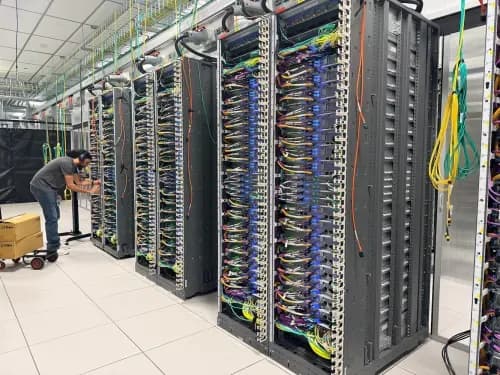
The data center boom is running into serious real-world obstacles, from widespreadlocal oppositionand permitting delays to ascramble for electricity. Before those challenges even come into play, though, there’s a more basic problem: A lot of the projects being announced may never get built in the first place. Withbillions of dollarsin AI infrastructure investment at stake, separating realistic projects from speculative ones is becoming increasingly important. On this episode of TechCrunch’sEquitypodcast, hosts Rebecca Bellan and Tim De Chant are joined byBrent Nelson, senior managing director of markets and strategy atAscend Analytics, to separate the data center projects that are likely to get built from the ones that may never get off the ground. Listen to the full episode to hear about: Subscribe to Equity onYouTube,Apple Podcasts,Overcast,Spotifyand all the casts. You also can follow Equity onXandThreads, at @EquityPod.
View

A key figure in Meta’s growth into a social media and tech industry powerhouse is leaving the company. Santosh Janardhan, the company’s longtime head of infrastructure and co-head of engineering, will be stepping down, Meta told TechCrunch. He will be replaced by Dave Brown, who joined the company as vice president of infrastructure earlier this year, the company added. Previous to coming aboard at Meta, Brown spent 19 years at Amazon, where he focused on compute, cloud, and AI,his LinkedIn shows. It sounds like Janardhan will remain at Meta for a little bit, although he is expected to leave next year. “Santosh will stay on for transition and he is moving into an advisory role on Meta Compute,” said a Meta representative. Janardhan, who originally joined the company in 2009, helped the firm grow into the massive internet presence that it is today. Bloombergoriginally reportedJanardhan’s departure, citing an internal memo that had recently been circulated. It’s unclear why Janardhan is stepping down from the role. The memo did not specify the reasons for his departure and Meta didn’t immediately respond to a request for clarity on the issue. However, Janardhan’s memoapparently citedthe need to “pass the baton.” In recent years, the company’s investment in infrastructurehas exploded, as it seeks to keep up with its competitors in the AI race. Earlier this year, Janardhan was taskedwith leading Meta Compute, the company initiative to scale its data center investments and strategy.
View

Loading the player… The data center boom is running into serious real-world obstacles, from widespreadlocal oppositionand permitting delays to ascramble for electricity. Before those challenges even come into play, though, there’s a more basic problem: A lot of the projects being announced may never get built in the first place. Withbillions of dollarsin AI infrastructure investment at stake, separating realistic projects from speculative ones is becoming increasingly important. On this episode of TechCrunch’sEquitypodcast, hosts Rebecca Bellan and Tim De Chant are joined byBrent Nelson, senior managing director of markets and strategy atAscend Analytics, to separate the data center projects that are likely to get built from the ones that may never get off the ground. Subscribe to Equity onYouTube,Apple Podcasts,Overcast,Spotifyand all the casts. You also can follow Equity onXandThreads, at @EquityPod.
View
View