🚀 Zaprep: Your Socials on Steroids. Start free — automate 1,000 DMs/month & turn engagement into leads. with 1,000 automated DMs/month.
Submit your Tool
PoweredByAI.app is an AI Tools Directory helping individuals, businesses, and creators discover the best AI tools for writing, coding, design, productivity, and more.
© 2026 , Product of011BQ. All rights reserved.

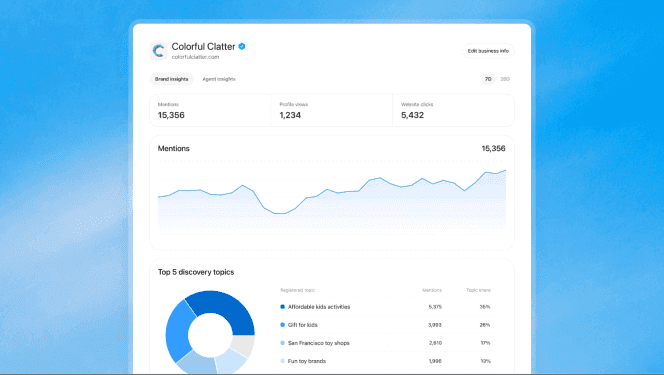
In an effort to make ChatGPT an even better consumer discovery engine, OpenAI is launching a host of new features designed to help companies control how users interact with their businesses. On Tuesday, the company rolled out a Business Hub that will serve as a place where companies can create business profiles that — in a feature that greatly resembles thekind of profilesthat Google and other search engines already offer — allow enterprises to verify and update information about their products and services. The feature is currently in beta. Eligible companies will also be able to create and launch a specialized business agent, which gives ChatGPT users the ability to ask questions about the business and its products. “As people turn to AI to discover products, compare options and make decisions, ChatGPT has become the platform for people and businesses to connect through AI,” the company said on Tuesday. “Today’s announcement is an early step in bringing businesses more deeply into ChatGPT.” In a move that calls to mindGoogle Analytics, the Business Hub will also give users access to limited business insights. These insights will reveal how ChatGPT users interact with their products — including profile views, business mentions, website clicks, and other metrics. Businesses will have to verify their profiles through a formal process, although the company did not share specifics of what that process would entail. Benji Shomair, OpenAI’s VP of Monetization, told journalists on Monday that there are “multiple verification methods that we use for different types of business in different markets.” OpenAI previously tried to position ChatGPT as an e-commerce hub by which users could buy products directly. This effort — which used a commission fee system — was viewed as a potentially huge source of revenue and a way to make ChatGPT a more direct Amazon competitor. However, that project ultimately failed to take off and, in March, the companyretired the effort, which had even included a “checkout cart” feature. With the integration of business profiles and intelligence, ChatGPT seems to be attempting to become more like Google, which — since the advent of the internet — has been the place where web users go to understand the companies they want to shop at. It remains to be seen whether this initiative will bear better results than the one that sought to make ChatGPT a direct e-commerce hub.
View

David Turturean, a recent MIT graduate and a member of the technical staff at the startup labPhysical Superintelligence (PSI), used early access to Anthropic’s Fable 5.2 model to solvean 18-year-old problemabout quantum computing. “I’m totally accepting the idea that this might be the last paper I ever put out,” Turturean, who deferred plans to pursue a master’s at MIT’s prestigious computer science and AI lab to join PSI, told TechCrunch. “In a few months, like, why would you even put out a paper?” The problem in question, the Aaronson-Ambainis conjecture, concerns the ability of quantum computers to solve problems faster than classical ones. Scott Aaronson, one of the two researchers who posed the problem,writesthat he doesn’t quite understand the proof but that he believes it’s correct because it was autoformalized in Lean, a coding language for math, andexplainedby a team of top researchers with whom PSI shared the solution. The solution appears to close the door on one avenue quantum computers could follow to solve certain difficult problems at high speed, but not all of them. “It’s a negative result that allows people to know, okay, we’re no longer looking there,” Turturean said. More broadly, it reflects the upheaval in the scientific world caused by AI problem-solving. “A proof of full [Aaronson-Ambainis conjecture] was one of the last remaining open problems in quantum query complexity that everyone seemed to agree was centrally important,” Aaronson, who described himself feeling satisfied, awestruck, disappointed, and fatigued by the news, wrote. “I was surprised, honestly, to see it missing from OpenAI’s Mathocalypse dump a few weeks ago. Surely they tried it, so was it really so much harder than all the problems that were solved?” That’s a point in favor of PSI’s model, which is to solve scientific problems with specialized model harnesses and scaffolding. “An effective kind of research system should have lots of things related to harnesses, lots related to tools, memory systems, simulation infrastructure,” PSI CEO Matt Pines told TechCrunch. “You want to be able to really go after a problem at breadth and depth, and be able to consider a wide range of potential alternatives.” For now, the company’s revenue comes from using its tools to optimize data centers, simulating the variables of heat, power, water, sound — “where the performance of that site as well as its impact on the community are a direct function of its physics.” The long play, however, is converting theoretical physics breakthroughs into actual technologies. “Six to nine months ago, when I was talking to investors, like I had to sort of stretch to validate that conditional, right? Like, ‘no, no, no, trust me, pretty soon, theoretical physics is going to be mostly the domain of machines,’” Pines said. “And it’s not there yet, but it’s on its way.” Still, while AI has claimed important solutions in fields like mathematics and computer science where it’s possible to express them in validated code, doing so in less abstracted disciplines like the life sciences or physics has proven more difficult. Last week, the startup Discovered Materials released a $1 million grand challenge for researchers using AI to understand problems like superconductivity and heat dissipation. “At the end of the day, physics is different than math because it’s the real world … nature gets a vote in your models of reality,” Pines said. He said the startup is focused on understanding how to take computational results and validate them with experiments in the most efficient way possible. “If it’s a true fact of nature, that’s a trick that you can exploit,” Pines said. “You could build a device out of it, right? The AI suggests an idea; it allows you to do something in the world you weren’t able to do before … and so each of those are kind of loops that PSI is building.” As “neolabs for science” become a pathway for potentially groundbreaking science, the participants are still figuring out what the standards are for this new world. Because PSI had to hold its result until Anthropic’s model was nearly ready for release, they were able to share it with relevant researchers to better understand it. “As an academic, we wanted to play our role in doing things the right way,” Jim Halverson, a professor at Northeastern University who advises PSI, said. He’ll be attending a summit at MIT next week where leading physicists will try to hash out a response to the new pace of science. “Best practices are still emerging … We figured that transparency is a good way to go, and contacting experts is a good way to go.” “We had some time to sit on it … and it was the first time that I actually took one of my AI-elicited solutions on print, and I read through it, and I was like, okay, how can I make this … be presented more naturally for a human?” Turturean, who said the academic community will expect him to be able to explain the result, told TechCrunch. “And I think it also made me realize, oh my God, the weight of what AI can do.”

Ouraannouncedon Tuesday that it’s acquiring AI-native primary care company Counsel Health for $625 million. The deal comes a few weeks after Ourapostponeditsup to $2.2 billion IPOindefinitely, citing “uncertainty in the IPO market.” Counsel Health is an AI-powered healthcare platform that combines a chat-based medical experience with access to licensed physicians. Its service was integrated into the Oura app in June. Users can connect with Counsel’s medical AI to get personalized medical advice, and chat with a physician when needed, all within the Oura app. Now, the companies plan to expand on their existing partnership to build across preventative care, acute care, and specialty and chronic care. While Oura has largely dominated the smart ring market for years, rivals like RingConn and Ultrahuman are emerging to dethrone it, putting pressure on the company to keep innovating. By acquiring Counsel Health, Oura is looking to expand its business and help users access medical care. “Oura helps members understand their physiology and, with Counsel, they can take action on their health across a range of needs, from quick questions and prescriptions to lab results, chronic care, and referrals,” said Oura CEO Tom Hale in apress release. Counsel Health raiseda $25 million Series Aa year ago, led by Andreessen Horowitz (a16z) and GV. PitchBook estimates it had raised a total of $36 million. Following the acquisition, Oura says Counsel will continue serving existing and new enterprise partners, with the goal of expanding its AI-native care model to more people beyond Oura’s membership. Counsel CEO Muthu Alagappan will join Oura as chief clinical AI officer, alongside the company’s 70 employees,Bloombergreports. “At Counsel, we’ve built medical AI around trust, safety and responsibility, keeping physicians in the loop for clinical decisions,” Alagappan said in the press release. “Oura’s data gives clinicians objective context, trended biometrics, and member engagement to deliver more informed care. From the start, our teams bonded over a joint vision, shared culture, and mission, further solidifying as we negotiated our deal over the past few months.” The deal is expected to close before the end of 2027. Oura also announced that its revenue grew 153% year-over-year to $533 million for the quarter ended on September 30. For its fiscal year 2026, Oura generated revenue of approximately $1.75 billion, marking 92% year-over-year growth. The company reached an$11 billion valuationfollowing a $900 million late-stage funding round in October 2025.

As Anthropic barrels toward an enormous IPO that could value it at$1.4 trillion,the company has disclosed a tidbit in its new S-1 filing about how many shares each of its seven co-founders plan to sell. Each will sell 3,378,378 shares. Anthropic has floated an unusually broad initial price range of $70 to $78 a share. At the midrange of $74, each founder would take in just shy of $250 million. At the low end, $70, each would have to settle for pocketing just over $236 million in cash; at the high end, $78, each would take in just under $264 million. However, in an IPO as eagerly anticipated as this one, companies can often price shares above the initial range. The S-1 is already hinting at high demand. Board member Reed Hastings has indicated he wants to buy $300 million worth of shares through his donor-advised fund. Board member Christopher Liddell also wants to buy $3 million worth of shares. The seven co-founders are Dario Amodei, CEO; Daniela Amodei, president and chair of the board; Tom Brown, chief compute officer; Jack Clark, head of public benefit; Jared Kaplan, chief science officer (pictured above); Sam McCandlish, chief architect; and Christopher Olah, interpretability research lead. After the sale, each of them will own about 3.2% of the total outstanding Class A shares, the S-1 says, or roughly 22% collectively. That’s not their share of the company overall. Class A is just one of Anthropic’s share classes, and other holders, including Amazon and Google, hold nonvoting Class N shares, so the founders’ stake in the company’s total equity will be considerably smaller. Even still, they, as a group, remain in control of the company. Each will also receive one share of Class F stock, which carries supervoting rights. Collectively, the founders will control 51.1% of the votes, but no single founder will hold significantly more shares or votes than the others. As is now industry lore, the seven left OpenAI to start Anthropic in 2021 after disagreements with OpenAI’s leadership over how AI should be built. Siblings Dario and Daniela Amodei, who held senior research and policy roles at OpenAI, were joined by five fellow OpenAI colleagues in forming a company that has said, very publicly and from the start, that it’s more focused on AI safety than its rivals, including the founders’ former employer.

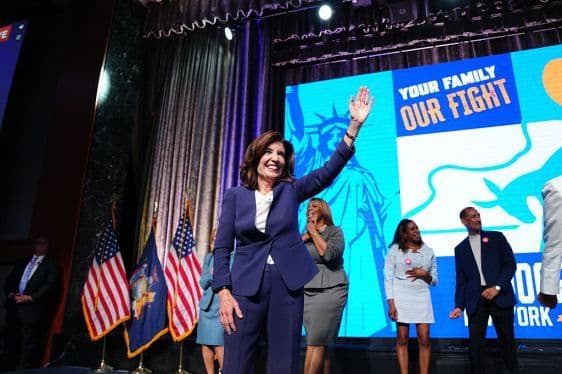
New York is gearing up to enforce one of the country’s most significant AI safety laws. The state opened a registration portal Tuesday, with which large frontier AI developers like Anthropic and OpenAI will be required to register by January 1, 2027. The RAISE Act, New York’s safety and transparency bill, kicks in at the start of the year. It mandates that large frontier developers — companies with more than $500 million in annual revenue — have to publish safety frameworks on their websites, report critical safety incidents within 72 hours, and issue public model transparency reports. The newly formed Office of Digital Innovation, Governance, Integrity, and Trust (DIGIT) will implement the RAISE Act and oversee large frontier AI labs. Penalties can be as high as $1 million for one violation and $3 million for subsequent violations. The state also can bring enforcement actions against companies that fail to register with the new portal, though a spokesperson declined to provide specifics. “Tech moguls tell us that their vision for AI is inevitable,” Governor Kathy Hochul said Tuesday during a press briefing. “They tell us get on board or get left behind… That any collateral damage is worth it as long as we win the race to the AI cliff.” On Tuesday, Hochul also launched the New York Center for AI Responsibility and Research based at State University of New York’s Binghamton University. The center will independently evaluate the safety, security, and operation of advanced AI systems and work with DIGIT to review companies’ safety frameworks. Hochul first announced the center in January with $55 million in donations and capital. “We’re building a national model for smart, sensible AI regulation, a model that puts communities above corporations and people above powerful technology,” Hochul said. The RAISE Act isn’t the only safety law New York has passed. Last year, the state began enforcinga law that requires AI companionoperators to regularly let users know they’re talking to a bot, and to make reasonable efforts to detect suicidal ideation and self-harm. In October, Hochul signed aseparate chatbot safety lawfor minors, restricting behaviors like deceptive human-like interactions, emotionally manipulative or sycophantic responses, and encouragement of behaviors like suicide or disordered eating. That law takes effect June 1, 2027. Other states have also passed similar AI safety and transparency bills to the RAISE Act. California’s SB 53, which took effect in January, mandates that frontier AI labs have in place and publish safety frameworks, enact whistleblower protections, and report critical safety incidents within 15 days. Illinois’ SB 315, which will go into effect at the start of 2027, has similar requirements, plus includes independent safety compliance audits.

OpenAI has acquired an AI travel agent called Odessia,according toOdessia’s founder, Francis Davidson. Davidson says in a post announcing the deal that he’s now working for OpenAI, helping the AI lab with the future of travel. Terms of the deal were not disclosed, but this looks like an acqui-hire. Davidson’s announcement focused largely on how he built his AI travel agent Odessia by directing teams of AI agents. The year-old Odessia raised a $6 million pre-seed round led by Sequoia and launched its AI travel agent around five months ago. Davidson says that it had helped early adopters plan millions of dollars’ worth of travel, but the toolhas already been shut down. An OpenAI spokesperson confirmed the hire to TechCrunch. “We’re thrilled to welcome Francis to OpenAI. Francis is a proven founder who has built multiple businesses to help people travel, and we’re excited he’s chosen to build with us.” However the AI lab has not announced new travel-specific products or plans. It does, however, count such companies as Bookings.com,Expedia, and KAYAK as customers or partners. Travel is also one of the main areas that people are using personal AI assistants to help with. And, back in July 2025, when OpenAI launched itsChatGPT agent, it mentioned travel as one of its potential uses. OpenAI’s spokesperson didn’t have more to share on its plans for travel-related products, except to say that travel is one of the areas that chatbot users frequently ask about. “1.2 billion people turn to ChatGPT each week for help with everyday tasks — from understanding their health, figuring out what to make for dinner, building a budget, and even planning a trip. We see a real opportunity to make these experiences even more useful,” the spokesperson said. Acquiring Odessia is interesting for another reason. Davidson is well known in the travel industry after he founded a travel startup called Sonder as a college student in 2014. It was sort of like Airbnb, but it focused on short-term leasing of upscale apartments in major cities worldwide. The pandemic badly hurt it, and as it climbed out of that rut, it went public via a SPAC but didn’t raise as much money as it needed, Davidson later saidin a post announcinghis resignation as CEO in June 2025. When a key partnershipwith Marriott fell through, the company went into bankruptcy and wound down. The bankruptcy trustee sold Sonder’s name, trademarks, and website domain in 2026 to TravelAI, and that website operates as a curated guide to the kind of travel rental properties that Sonder was once known for. Prior to its downfall, Davidson had built Sonder into a unicorn with $143 million in revenues. While Sonder was not, ultimately, a success story, Davidson is the kind of battle-scarred founder that Silicon Valley often values. So we’ll have to wait and see what OpenAI has in store now with travel, now that he’s joined the company. Note: This story was updated with OpenAI’s comments.

TPU 8tx is built for confidential AI inference, allowing enterprises and governments to process sensitive data.
View

The US president believes NVIDIA CEO Jensen Huang didn’t have any knowledge of being targeted by Chinese intelligence.
View

The Power plan is listed at ₹1,799 and the Maximum tier at ₹8,999, although Meta has not confirmed an India launch date or the prices.
View

As AI changes engineering delivery, larger IT services firms are buying specialist capabilities. The challenge is turning those acquisitions into new business.
View

The expansion will place millions more teenagers under Instagram's Teen Account restrictions, even if they registered as adults.
View

Qantas will move some corporate services to Accenture teams in India as part of a technology overhaul that will introduce more automation and AI.
View
View
View
View
View
View