🚀 Zaprep: Your Socials on Steroids. Start free — automate 1,000 DMs/month & turn engagement into leads. with 1,000 automated DMs/month.
Submit your Tool
PoweredByAI.app is an AI Tools Directory helping individuals, businesses, and creators discover the best AI tools for writing, coding, design, productivity, and more.
© 2026 , Product of011BQ. All rights reserved.

Indic AI companies raised $399 million in 2026 through October 15, with Sarvam accounting for about 87% of the year's funding, according to Tracxn.
View

The PHP scare may have faded from your feed, but the cleanup is far from over. Last week, two critical bugs in the open source language behind roughly 70% of websitesleft organizations scrambling to fix their systems, with some taking sites offline until the vulnerabilities could be patched. According to researchers who found the bugs, this is only the beginning, as AI changes how quickly novel vulnerabilities can be uncovered and exploited. On this episode of TechCrunch’sEquitypodcast, Rebecca Bellan talks withTomer Schwartz, CTO of Exposure Management & AppSec at Google-owned Wiz, who was part of the scramble — alongside OpenAI, research group Calif, and the PHP team — to fix the bugs. On the show, Schwartz and Bellan get into what the race looked like from the inside, how early-stage startups can build with security in mind, and why patching by hand won’t scale. Listen to the full episode to hear more about: Subscribe to Equity onYouTube,Apple Podcasts,Overcast,Spotify, and all the casts. You can also follow Equity onXandThreads, at @EquityPod.
View

Loading the player… The PHP scare may have faded from your feed, but the cleanup is far from over. Last week, two critical bugs in the open source language behind roughly 70% of websitesleft organizations scrambling to fix their systems, with some taking sites offline until the vulnerabilities could be patched. According to researchers who found the bugs, this is only the beginning, as AI changes how quickly novel vulnerabilities can be uncovered and exploited. On this episode of TechCrunch’sEquitypodcast, Rebecca Bellan talks withTomer Schwartz, CTO of Exposure Management & AppSec at Google-owned Wiz, who was part of the scramble — alongside OpenAI, research group Calif, and the PHP team — to fix the bugs. On the show, Schwartz and Bellan get into what the race looked like from the inside, how early-stage startups can build with security in mind, and why patching by hand won’t scale. Subscribe to Equity onYouTube,Apple Podcasts,Overcast,Spotify, and all the casts. You can also follow Equity onXandThreads, at @EquityPod.
View
The financials Anthropic shared with investors this week suggest that its AI coding tool, Claude Code, is every bit the business success the frontier lab wanted. The company recorded an operating profit in the second quarter, and 900% net revenue retention — that is, spending from the same customers in Q3 2025 grew nine times in Q3 2026. Anthropic has focused on gettingenterprise users to stick aroundand Wednesdayannounceda new suite of reporting tools designed to give those customers a more granular understanding of the value they get from their token spend. Using internal analytics and employee surveys, managers can view a team’s work over a given date range, what the team produced, how much it cost, and where its workflows broke down. Anthropic says it won’t use this data for model training by default. The reports will also offer recommendations on how to improve the results. This is a clear attempt to demonstrate the return on investment of Anthropic’s tools and to show customers how to improve it — a major concern among large customers. Anthropic is also creating pooled group budgets to allow teams to better manage token spending. Businesses have been hunting for that kind of information as they figure out how best to deploy AI tools. While usage among venture-backed firms is driving token spend, most of the Fortune 500 are not seeing major gains from deploying AI. Jellyfish, a company that makes tools for software developers, released anew report yesterdaybased on the use of agentic coding tools by 276,000 of its customers. Claude Code and other tools built on Anthropic models remain the most widely used in the survey, responsible for nearly a third of all proposed code changes submitted for review. More importantly, spending on those tools has grown 10x since the beginning of the year, with their cost now equal to about 2% of total engineering cost. “Even if you’re saying 2% is still small, that 10x growth is growth that most CFOs didn’t plan for,” Nicholas Arcolano, the chief scientist at Jellyfish, told TechCrunch. We’re certainly getting to the point where people are realizing, okay, it’s not enough to just spend a bunch. You now have to optimize it, make it work.” Anthropic’s new reports speak to that challenge. Anthropic leads among enterprise customers, but what makes an agentic coding tool truly sticky is difficult to identify. The release of OpenAI’s Astra model this summer seemed like a potential threat to Anthropic, but so far it hasn’t slowed Anthropic’s adoption numbers. “It took a long time for us to see Codex really pop in our data at all, and it has come up with Astra [OpenAI’s latest model],” Nikolas Albarran, the AI product lead at Jellyfish, told TechCrunch. Looking at X, he continued, you’d get the distinct impression that the competition is more heated. “Everyone in the Valley is like, ‘Oh, Codex is better.’” In reality, Albarran continued, “Anthropic was just there with great enterprise motions, and they had an incumbent weight of their own — this stuff just worked and worked well, and a lot of people just put a lot of effort into standardizing workflows around it. And there’s not a big enough reason to switch.” It’s not just a question of models and workflows, either. The realities of business mean that once a frontier lab has gotten its hooks into a customer, switching is harder than it is compared to an individual programmer or small organization. Albarran points to the investment all the major AI labs are making in forward-deployed engineering (FDE) organizations, teams that embed AI consultants inside customer organizations to help them get off the ground. These new reporting tools can be seen as a kind of FDE-lite, a lighter version of that hands-on help, for Anthropic customers. “We’re at a point now where it’s mature enough, where once you’re in, it’s going to be harder and harder to switch because you’ve spent the effort,” he said. “Even if they’re all mostly the same, they’re all going to be slightly different, have their own slight quirks of how they handle agents to ND files, etc., and so that cost to switch is not zero.”

Whatever the future of AI might be, the current situation is still very good for Microsoft. The tech giant reported yet another quarterly revenue record on Wednesday:$92.3 billion, a 19% increase over the year-ago quarter. Microsoft has now reported record-breaking revenuefor 10 quarters in a row. This is profitable revenue, too. Microsoft reported that net income reached $36.6 billion, an increase of 32% on a GAAP basis, over the year-ago quarter. The record-breaking income was largely driven on the strength of Microsoft Cloud, which reached $63.9 billion in revenue this quarter, an increase of 30% over the year-ago quarter, Microsoft said. Microsoft has reorganized its business reporting into two basic segments: 1) Agents and Infra and 2) Devices and Consumer. On the flip side, revenue in Devices and Consumer was $15.5 billion, decreased of 3%, with Windows OEM and devices revenue falling 22% from the year-ago quarter. True, not all of Microsoft’s healthy cloud revenue can be attributed to AI. Microsoft 365 accounted for nearly $28 billion. But Azure brought in the most, at $33.2 billion. And again, not all of that is necessarily AI-related. Enterprises run all sorts of the traditional software and SaaS applications on Azure. Still, a good chunk of the revenue was from AI, because Microsoft alsoreported $10 billion in revenue from OpenAI. Despite branching out to AWS, Oracle, and others, OpenAI still runs a lot of its services on Microsoft’s cloud. (Anthropic runs on Azure as well.) Microsoft also said its “commercial remaining performance obligation increased 73% to $677 billion.” That represents future revenue committed under existing contracts of the AI labs. But, like all the big cloud providers, Microsoft is also spending big to prepare to deliver on those commitments. Capital expenditures topped $45.2 billion, another all-time quarterly record.
View

Microsoft generated $10 billion in revenue from commercial arrangements with OpenAI, including revenue-sharing payments, in the quarter ended September 30, the company said in regulatory filing on Wednesday. That represents nearly 11% of Microsoft’s total quarterly revenue of $92.3 billion, highlighting the enormous financial ties that remain between the two companies even as they increasinglycompetefor thesame customers. (Microsoft’s financial year begins in July, making the quarter ended September 30, 2026 the first quarter of its fiscal 2027.) For the full 2026 fiscal year, revenue from OpenAI hit $24.1 billion. At its latest quarterly pace, Microsoft would pull in $40 billion annually from OpenAI-related arrangements. Microsoft also reported $7.2 billion in outstanding receivables from OpenAI at the end of September, up from $6 billion at the end of June. That money represents amounts OpenAI owes for previous transactions, not additional revenue. It’s not clear how much of Microsoft’srevenue from OpenAIcame from revenue-sharing payments or Azure cloud computing services. TechCrunch has reached out for more information. In November 2025, TechCrunchreported, citing leaked documents, that Microsoft had received $865.8 million in net revenue-sharing payments from OpenAI during the first nine months of that year. OpenAIreportedlyshares 20% of its revenue with Microsoft as part of a previous deal in which the software giant invested more than $13 billion in the AI startup. (Neither the AI lab nor Microsoft have publicly confirmed this percentage.) As part of an April 2026 agreement, OpenAI is on the hook to conitnue sharing revenue with Microsoft through 2030, subject to a cap, even as OpenAI is allowed to work with competing cloud providers. The companies began loosening the ties of their once-exclusive partnership in October 2025, when Microsoft relinquished its hold on OpenAI to give the startup more freedom to partner with other cloud providers. In exchange, OpenAI committed to buying an additional $250 billion in Azure services as part of an October 2025 agreement. Microsoft’s ownership stake in OpenAI has also declined slightly from about 25% in June to 24% in September. That continues a gradual decline from roughly 27% following the October 2025 recapitalization. Microsoft did not specify what caused the dilution.

Google is bringing ads in its AI-powered Search experiences to international markets, betting that generative AI can open up new revenue opportunities even as growth in its core search advertising business slows. The announcement came Wednesday during Alphabet’sthird-quarter earningscall ,as the company reported $127.6 billion in revenue, up 25% year over year. But Search advertising growth continued to decelerate, and Alphabet shares fell 8% following the results. Google Search revenue grew 12% year over year in the third quarter, down from 17% growth in the second quarter and 19% in the first quarter. The slowdown puts added pressure on Google to turn its expanding AI features into a meaningful source of advertising revenue. “We are now scaling high-quality ads within AI overviews in AI mode to more users and queries,” Philipp Schindler, Google’s chief business officer, said during the call with investors. “This includes taking our monetization footprint global for the first time. Today, we’re announcing the expansion of ads in AI mode into international markets alongside multi-turn ads and AI mode in the U.S.” Google says early results suggest the formats are working. Click-through rates for sponsored product listings in AI Mode are already comparable to those for organic listings, according to Schindler. The company’s user research also indicates that people find the ads relevant. The move builds on Google’s Mayannouncementof new Gemini-powered ad formats, including conversational discovery ads that respond to users’ questions and sponsored recommendations integrated into AI-generated answers. Google CEO Sundar Pichai also said that Search queries grew at their fastest year-over-year rate in five years, though he did not disclose the exact growth rate. He credited AI features with changing how people use Search, including prompting longer and more complex queries. Queries in AI Mode are three times longer on average than traditional searches, Pichai said, while one in five AI Mode searches globally involves voice, images, or documents. Google has also surpassed 50 billion visual searches per month. “[Search] is bringing the benefits of AI to more people than any other product in the world,” Pichai told investors. “People are using our AI features more, searching in entirely new ways. Their queries are longer, personalized, and multimodal.” Alphabet’s Google Services division, which includes Search, generated $96.3 billion in revenue, up 11% year over year. Google Cloud revenue surged 103% to $30.7 billion. The results follow a busy quarter for Google, including the release ofGemini 4 Argon, the growth of the Gemini app toone billion monthly users, and the launch of itsPixel 11 lineup.

Microsoft has never disclosed Azure’s quarterly revenue in dollars. It has typically only shared a growth percentage or described revenue dollar milestones in vague ways. But on Wednesday, when it posted anotherrecord-breaking quarter, itreported that Azure brought in a healthy $33.2 billionin revenue for the July–September quarter, up 48% from a year earlier. The disclosure lets investors line up Azure’s performance more directly against Amazon Web Services and Google Cloud, whose parent companies already report cloud revenue in dollars every quarter. Alphabet, which also reported earnings on Wednesday, saidGoogle Cloud brought in $30.7 billionin the same quarter, putting Azure slightly ahead. But Google Cloud, which also includes Google’s Workspace subscriptions, roughlydoubledits revenue from a year earlier, growing about twice as fast as Azure, according to TechCrunch’s calculations. Azure, where businesses rent computing power to run applications, SaaS, and to build and run AI models, is now Microsoft’s largest and fastest-growing product line by the company’s own figures. It accounted for roughly 36% of Microsoft’s $92.3 billion in quarterly revenue. Azure’s revenue was also about $850 million more than the$32.3 billion analysts expected. Azure’s 48% growth rate also topped the 44% to 45% that Microsoft CFO Amy Hood forecast on the company’sJuly earnings call. Azure sits inside Agents and Infra, one of two new business segments Microsoft introduced this quarter.Microsoft previously reportedthree segments, Productivity and Business Processes, Intelligent Cloud and More Personal Computing. The new Agents and Infra segment, which groups Azure with Microsoft 365’s cloud business,brought in $76.8 billion, up 25% from a year earlier. Amazon reports its earnings on Thursday. Analysts also expect its cloud, Amazon Web Services, to grow. It’s been the largest cloud since the beginning of time and no one expects Microsoft to best it right now. But with all of them reporting actual dollars, the race is on.
View

Nvidia on Wednesday releasedNemotron 3.5 Transcribe, a free, open-weight model that transcribes audio in up to 40 languages. It also released version 2 of Granary, its open source speech dataset. Nvidia boasts that Nemotron 3.5 can translate 31 languages to and from English, handle recordings up to an hour long, and tell up to eight speakers apart. It claims to beat rivals on benchmarks, including Hugging Face’sOpen ASR Leaderboard. These tools target developers building apps for business meetings and medical transcription, two of AI’s most established footholds in the workplace. Nvidia says developers can use the model, the updated Granary dataset, and tools like its NeMo Speech model to customize apps to recognize an industry’s jargon in each language. One drawback: Transcribe works with recorded audio, not livestreams. Still, the company promises Transcribe, at 30 billion parameters, can run on a single chip, from the Jetson AGX Thor robotics controller and DGX Spark chippowering new laptops, to Blackwell datacenter chips. It joins Nvidia’s open-weight voice models, including the super small yetpowerful Parakeet(1.1 billion parameters). Nvidia’s latest voice entry comes during a busy period of AI voice releases: Mistralshipped Voxtral 3earlier this month; ElevenLabs launched Realtime for instant speech in voice agents; and Salesforce releasedLauna-Omni,its voice model.
View

South Korea’s financial institutions have been hit by another wave of cyberattacks, highlighting the growing risk of AI-driven hacking in Asia. The latest incidents affect brokerages Daishin Securities and Mirae Asset Global Investments, as well as the crypto exchange Bithumb. The incident comes roughly a month after aseries of cyberattackstargeting South Korean financial institutions, raising concerns about vulnerabilities beyond just the country’s banking systems. Security researcherslinkedthe September wave of attacks on South Korea to a suspected China-based hacker who relied on an AI penetration testing tool called Artex, though officials are still investigating the root cause of the latest breaches. According to local news,Daishin reported a cyberattack that exposed the personal information of 38,490 customers, including names, email addresses, and mobile phone numbers. The company has notified affected customers, is cooperating with authorities in the investigation, and will compensate for any losses as required by law. Meanwhile, Mirae and Bithumb reported separate cybersecurity incidents on Wednesday, perlocal media, though neither has confirmed that customer data was taken. South Korea’s financial regulator has called for stronger cybersecurity measures following a string of attacks on financial firms and government agencies,per officialsin Seoul on Wednesday. The country also plans to conduct security checks on dozens of IT systems in the private sector. Yesterday,Japan reporteda cybersecurity incident involving GMO Internet, following a series of attacks on its financial institutions. The wave of cyberattacks across Asia underscore growing cybersecurity challenges in the region, often as a result of years of weak cybersecurity; though, investigators have not established a connection between the incidents. South Korea’s Financial Services Commission (FSC), Daishin Securities, Bithumb, and Mirae Asset Global Investments did not immediately respond to requests for comment.
View

Former Yahoo CEO and early Google engineer Marissa Mayer is catching a lot of flak for how she uses AI. Inan interviewabout her new app Dazzle, an AI assistant that learns from your camera roll, Mayer poses what she believes is an impressive flex for the product: It helped her come up with three bullet points about her 10-year-old daughter for a birthday presentation at school, describing her as “empathetic, creative, and an animal lover.” It’s a vague description, like a generic horoscope — it could probably describe a lot of 10-year-olds. Some onlookers, like progressive activist Leah Greenberg,marveledthat “the fact that Marissa Mayer would voluntarily disclose this to a reporter is a pretty good demonstration of how deeply the culture of Silicon Valley has diverged from the rest of humanity.” "She thought it was perfect."www.nytimes.com/2026/10/25/s… Perhaps Mayer drew so much backlash because we have repeatedly observed sheltered billionaires suggest that we outsourcechild-rearing— one of life’s greatest tests of patience, humility, and kindness — to a computer that isincapable of understandinghuman emotion. We’ve been primed for this frustration. Last year, OpenAI CEO Sam AltmantoldBored Ape ownerand late night host Jimmy Fallon on national television, “I cannot imagine … figuring out how to raise a newborn without ChatGPT.” The public didn’t love that comment, either, but Altman wasn’t fazed by thenegativefeedback. A few months ago, he said on X that a “cool use case” of ChatGPT Work would be creating a podcast that talks about your kids’ upcoming birthdays or soccer games and “explain[s] your kids’ interests.” (He was brutallyratioedwithcommentslike, “What if you just talked to your children?”) After publication, Mayer defended herself in a longX post. She claims she was not relying on Dazzle to explain her child to her, but rather, she was testing what her prototype could do — it resurfaced photos of “forgotten kindergarten projects,” like a “snake devenomer” or “sandcat playground,” illustrating her daughter’s creativity and care for animals. Fair enough. But Mayerremarksin the same interview that people could also use her AI to outsource the mental load of “figuring out the theme for your child’s birthday party.” She says she’s used her app to plan a playdate for her daughter, book family activities on vacation, and decide what to be for Halloween. She even proposes that her AI assistant could coordinate plans with her husband’s AI assistant. When the reporter asks her if it’s depressing to imagine this “frictionless future … planned by AI,” Mayer replies, “I haven’t really thought that through.” These leaders seem to write off the naysayers as part of a small, angry fringe group. Yet a Pew Research Centerstudyreports that 50% of U.S. adults think that AI will reduce people’s ability to form meaningful relationships. Only 5% of respondents said AI would make it easier to build these connections. Meta CEO Mark Zuckerberg, however, joins his Silicon Valley kin in envisioning a world where our social needs are met via AI. “The average American I think has, it’s fewer than three friends, three people they’d consider friends, and the average person has demand for meaningfully more, I think it’s like 15 friends,” Zuckerberg said last year on apodcast. “The average person wants more connectivity, connection than they have.” Zuckerberg predicts that it will become more socially acceptable to outsource our emotional needs to AI therapists or even AI romantic partners. “There are all these things that are better about physical connections when you can have them,” he added. “But the reality is that people … feel more alone a lot of the time than they would like.” Zuckerberg goes on to explain how virtual-reality embodiments of AI avatars are only growing more realistic. Meta seems to be more keen on improving our relationships with these approximations of humans, rather than between the actual billions of humans who use its platforms each day. Maybe part of this stems from the culture of the tech industry, which prizes efficiency. People try to biohack their own bodies by optimizing theirsleep scheduleswith health trackers or injecting unregulated “peptide stacks” to maximize their productivity. If you’re building electric vehicles or computer chips, then sure, efficiency is a clear north star. But our relationships with other people are not a tech product that we’ve been challenged to ship with as little capital as possible. Human relationships are inherently messy, but our connections with one another can be what gives our lives meaning. When we delegate those interactions to computers, we surrender the difficult, yet fulfilling experience of being people.

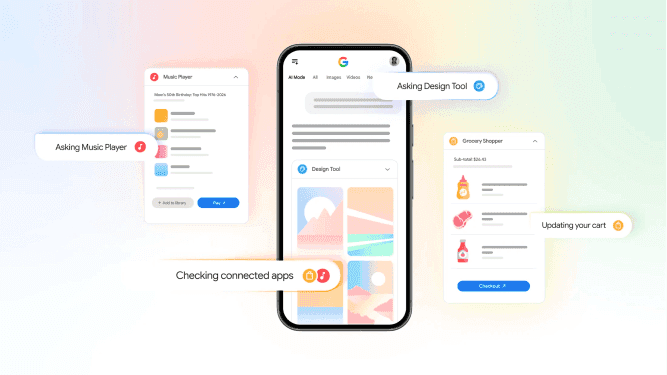
Google is making it easier for businesses to connect their apps to its AI experiences across Search and Gemini with the debut of its Connected Apps Platform. Introduced inGeminiandGoogle Searchearlier this year, connected apps let users securely link and interact with popular third-party services, then use them to take specific actions. For instance, you could connect to Canva to design a flyer, or to YouTube Music to build a playlist. We’ve seen varying takes on the idea by other consumer-facing AI services likeChatGPTand Meta’s Muse. The premise is that such integrations could ultimately shift consumer behavior away from launching and using individual apps to instead using their favorite services through their preferred AI provider. However, to successfully capture and retain consumers’ attention, there have to actually be a wide range of connected apps to explore. Google’s idea is to open its doors to any business or developer that wants to reach users through Search or Gemini by allowing them to submit their own connected apps and monitor their performance. The platform preview is currently available in beta to developers in the U.S., and will allow developers to build and submit apps that can be used across Google’s products. To get started, developers would integrate with a cloud-hosted MCP (Model Context Protocol) server or Android MCP using the AppFunctions APIs, then use the Google Connected Console to register, test, and submit their app, Google explains. Essentially, this process lets devs connect their app to Google’s services so it can be used with the search giant’s AI features. Developers can also choose whether they want their app to be available via Search, the Gemini app, or both. After the app is live, developers can track traffic, latency, and error rates, and maintain control over their brand identity, such as their verified logos and authenticated accounts. Similar to how SEO allowed companies and websites to show search engine rankings, this could well be one of the initial steps for businesses that want their services to be more visible to users on the agentic web. Google already hasover 50 Connected Apps available in Gemini,including from partners like Adobe, Experian, Localiza, Peloton, and others, in addition to its own expansive set of services, from Workplace and Photos to YouTube Music and Google Home. These apps will now come to Google Search over the next few weeks. Search today has fewer integrations, featuring apps like Instacart, Canva, YouTube Music, Yahoo Fantasy Football, and others. Google said meditation app Calm is another new partner on this effort, and that its app will soon launch on both Gemini and Search. The new Connected Apps platform is in public preview for U.S. developers who sign up for the waitlist. Google did not share when it would become more broadly available.
View
View
View
View
View