🚀 Zaprep: Your Socials on Steroids. Start free — automate 1,000 DMs/month & turn engagement into leads. with 1,000 automated DMs/month.
Submit your Tool
PoweredByAI.app is an AI Tools Directory helping individuals, businesses, and creators discover the best AI tools for writing, coding, design, productivity, and more.
© 2026 , Product of011BQ. All rights reserved.

Google launched its latest frontier AI model late last month, named Gemini 4 Carbon, with agentic and enhanced cybersecurity capabilities. The AI model was released just two weeks after the Mountain View-based tech giant released Gemini 4 Argon, another AI model with agentic capabilities. During the announcement, Google published multiple benchmark results to showcase the capabilities of the Gemini 4 Carbon. Now, SemiAnalysis has published results from its new GDPx benchmark that tests the agentic capabilities and cost efficiency of AI models, comparing results of multiple models. On the benchmarking platform, Google's frontier AI model came in second position, while being the most cost-efficient among the top five.
View

Samsung's first AI-powered smart glasses, reportedly called Intelligent Eyewear, are expected to go on sale in South Korea and the US in mid-December. According to a report, the initial launch will exclude markets such as Japan and Europe, with the company planning to expand availability depending on early demand. The smart glasses are built on Google's Android XR platform and integrate Gemini AI. They are expected to offer features such as real-time translation, voice navigation and automatic note-taking.
View

OpenAI is working with security firm Cathedral to find weaknesses in its systems. Researchers from both teams will use OpenAI's AI models to test its defences and check whether potential fixes work. The company is also raising rewards for critical vulnerabilities reported through its Security Bug Bounty programme by more than four times. The latest exercise follows an earlier round of security testing in which OpenAI assigned 25 percent of its product engineers to finding and fixing vulnerabilities.
View

Anthropic has introduced Message Threads in public beta on the Claude Platform. The new feature is intended to reduce response latency in long-running AI agent sessions. It eliminates the need to resend the entire conversation history with every API request. With Message Threads, developers can share new messages and the ID of the previous response to get responses. Anthropic confirmed that the new feature is enabled by default for most Claude Code users.
View

Google is said to be testing a change to its Search interface. According to a report, the Mountain View-based tech giant appears to be making its AI Mode less prominent for some users on Search. The dedicated AI Mode button has reportedly been removed from the Search bar on the web. It is, however, believed to be part of a limited experiment, and the feature itself may remain accessible to other users.
View

OpenAI launched its new specialised AI tool for managing personal finances earlier this year. Dubbed ChatGPT Finances, the tool was recently made available for Free and Go users in select global markets, allowing them to connect their financial accounts. Since its release in May in preview, the Sam Altman-led AI giant has added multiple features to the AI-powered financial management tool. Now, the company has announced the integration of ChatGPT Voice into ChatGPT Finances. The latest addition allows users to have hands-free conversations with the chatbot, eliminating the need for users to write prompts. ChatGPT Voice also lets users “talk through questions”.
View

Google introduced the Guided Learning tool in Gemini in August last year. The company positions the tool as a “learning companion” that allows students and teachers to learn more about different topics. Students can present a problem to the AI chatbot in Guided Learning mode to get a detailed step-by-step solution, helping them with their homework. It is also capable of designing practice questions for pupils. Now, the Mountain View-based tech giant has announced that it is bringing the Guided Learning tool to two new services, including Google Search and Google Classroom. Further, the company is bringing greater control for schools over how their students use AI.
View

IndiaAI Mission was approved by the Union Cabinet in March 2024, under the aegis of the Ministry of Electronics and Information Technology (MeitY). The initiative was launched with the aim of “Making AI in India and Making AI Work for India”. Now, MeitY has launched three new indigenous AI models from two AI labs, namely Soket Labs Technology and Research and ZenteiQ AiTech Innovations. Soket AI claims that its AI model demonstrated “advanced capabilities” in math, coding, reasoning, and agentic use. Meanwhile, ZenteiQ says that its open-source large language models (LLMs) offer support for 10 Indian languages.
View

Open source models are becoming more mainstream as enterprises, governments and startups alike rely on the promise of lower costs, more control, and more flexibility. But as increasingly capable models become more freely available, how do companies capture value? And with Chinese open models gaining ground, can American players keep up? On this episode of TechCrunch’s Equity podcast, Rebecca Bellan caught up withIrene Solaiman, Chief Policy Officer and SVP of Strategy at Hugging Face, about what startups need to know before building on open models, from choosing the right tools and infrastructure to navigating the trade-offs shaping the future of open AI. Listen to the full episode to hear about: Subscribe to Equity onYouTube,Apple Podcasts,Overcast,Spotifyand all the casts. You also can follow Equity onXandThreads, at @EquityPod.
View

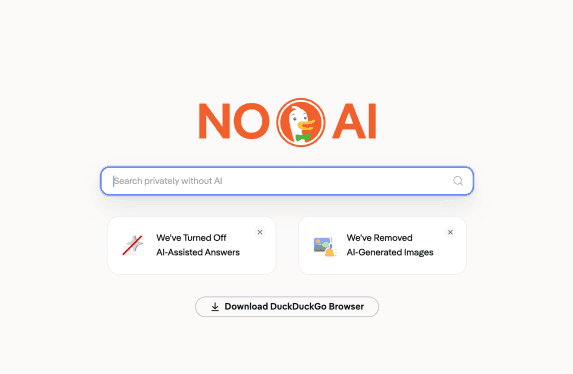
DuckDuckGois pitching itself to schools after Google created an opening for the alternative search engine. On Tuesday, Google told schools they couldturn off Gemini, but it said shutting off its other AI features wouldcost schools Google Search, as well. DuckDuckGo, a company that focuses on user privacy by limiting data collection, clearly sees this as a moment to make inroads in education, where Google has historically dominated. According to figures Google has published in previous years, there arearound 50 million Chromebooksin schools, used by students and educators, and its Google Classroom platform servesover 150 million usersglobally. On X, DuckDuckGo’s founder and CEO, Gabriel Weinberg, pointed to the company’sonline documentation, explaining how schools can switch their default search engine to DuckDuckGo’s service instead, adding, “get in touch for help.” Meanwhile, DuckDuckGo’s chief public affairs officer, Kamyl Bazbaz, issued a stronger statement,writing, “Forcing AI on school children: how a monopolist behaves when they think people are powerless. Prove Google wrong.” Forcing AI on school children: how a monopolist behaves when they think people are powerless.Prove Google wrong.https://t.co/Ta6ibmFdb9 In an email to TechCrunch, DuckDuckGo chastised Google for its decision, adding that Google could easily turn off Search’s AI features for schools if it wanted to. The company’s comments come as the American public is weighing how much AI they want to allow into their lives. As Tuesday night’s elections indicate, theydon’t want AI data centersbuilt in their towns. But using AI at work and school has become a common practice and requires a more nuanced discussion. Knowing that educators have struggled with AI, Google developed technology called “Guided Learning” that is meant to help kids learn by walking through problem-solving steps rather than just providing them with an answer. But educators are still asking for tools that let them remove AI from the learning process altogether. After the backlash on Tuesday, Googledefendedits decision, saying it was just responding to schools’ feedback. It said that Gemini, Gemini Notebook, and Search would be off by default, and schools could choose to enable them individually. We want to clarify what we announced today about our education services. Today’s announcements give schools more choice, not less. Here’s what we announced:– Gemini, Gemini Notebook, and Search will be OFF 🔴 by default. This is based on K-12 schools asking for more control… The problem, of course, is that Google Search now heavily uses AI, through AI Overviews and a conversational AI Mode that answers users’ queries. DuckDuckGo isn’t anti-AI, to be clear — it offers its own set of AI features, including a chat interface called Duck.ai and an AI search assistant. However, unlike Google, it provides options to disable these features in both its search and browser settings, the company says. It also offers a dedicated website,noai.duckduckgo.com, where AI-assisted answers, AI-generated images, and AI feature suggestions are all turned off. That flexibility may be driving demand for its services, as the companyreported earlier this yearthat its app installs were up 30% as users rejected being force-fed Google’s AI Search.

Loading the player… Open source models are becoming more mainstream as enterprises, governments and startups alike rely on the promise of lower costs, more control, and more flexibility. But as increasingly capable models become more freely available, how do companies capture value? And with Chinese open models gaining ground, can American players keep up? On this episode of TechCrunch’s Equity podcast, Rebecca Bellan caught up withIrene Solaiman, Chief Policy Officer and SVP of Strategy at Hugging Face, about what startups need to know before building on open models, from choosing the right tools and infrastructure to navigating the trade-offs shaping the future of open AI. Subscribe to Equity onYouTube,Apple Podcasts,Overcast,Spotifyand all the casts. You also can follow Equity onXandThreads, at @EquityPod.
View

Meta has acquiredConductor, an AI coding startup that allows users to spin up software projects by deploying multiple agents into parallel workspaces. The news wasoriginally reportedby Axios, and Conductorshared newsof its acquisition on its blog. “I have big news: Conductor is joining Meta,”wrotethe startup’s founder and CEO, Charlie Holtz, on Wednesday. “We have some big, crazy plans for the next interface,” he added, teasing that the company would have “something new” for customers to use by “early next year.” On X, Holtzalso notedthat he was looking forward to working with Alexandr Wang, Meta’s chief AI officer, and Nat Friedman, head of product at the company’s Superintelligence Labs. “They’ve been on an absolute tear, and I’m convinced MSL has the highest talent density of all the labs,” he added. Meta confirmed the acquisition to TechCrunch but wouldn’t comment further or provide additional details about the deal. Conductor, founded in 2024, only launched its core product just last summer. The company’s agentic teams, which can be deployed in the cloud, locally, or via a user’s phone, are designed to help software engineers work on separate, compartmentalized parts of a project in concert. The agents that the platform deploys aren’t developed in-house but come from major labs like Anthropic and OpenAI. Holtz said that, until early next year, Conductor’s core features would continue to work as they previously have. The exception is Conductor’s cloud service, which will shut down on November 20, after which the company will begin deleting user cloud data. Meta, which previouslylagged behindin AI services, has spent the last several months trying to catch up. In August, the companylaunched Muse Code, its own coding agent. Meanwhile, the company’s recently launched Muse agents are seeing significant adoption, with the companyrecently reportingthat the service had surpassed 10 million users. The company has also made a number of AI-related acquisitions over the past year,including Moltbook, the viral agent platform that made headlines.
View
View